
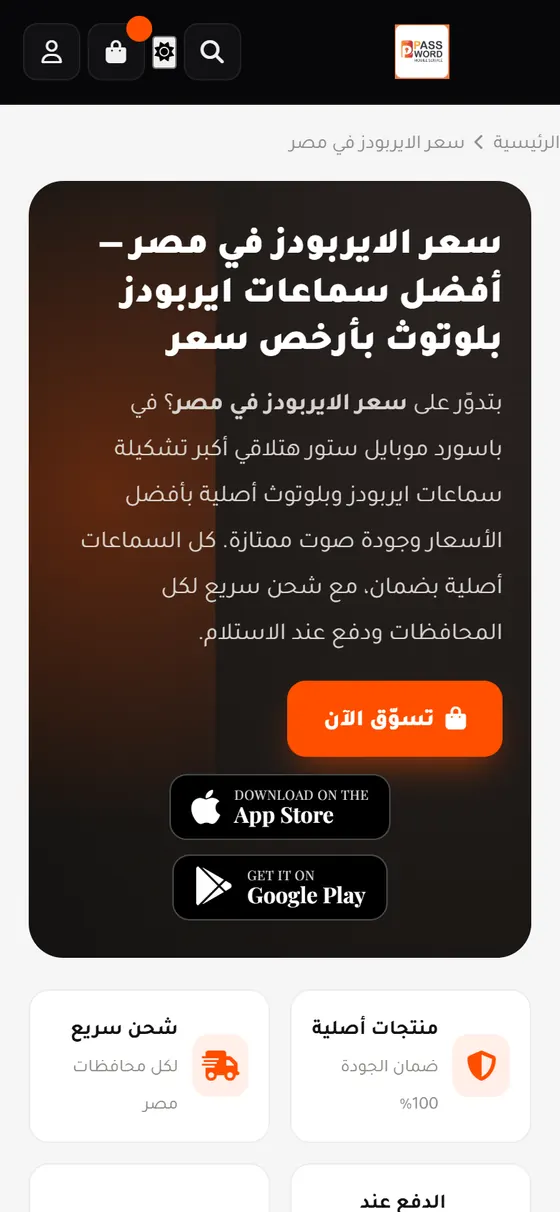
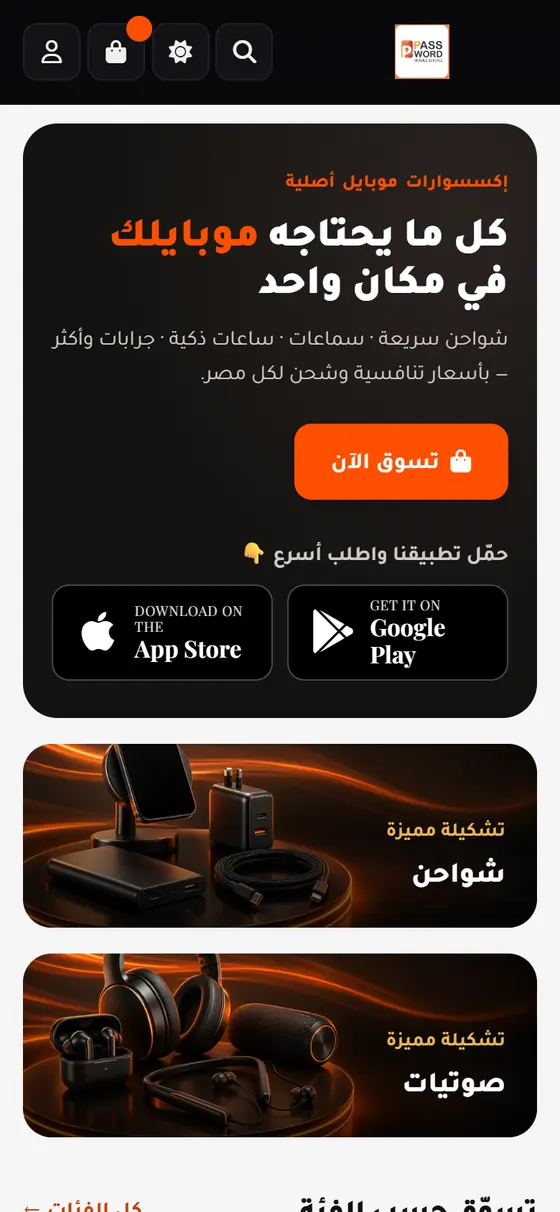
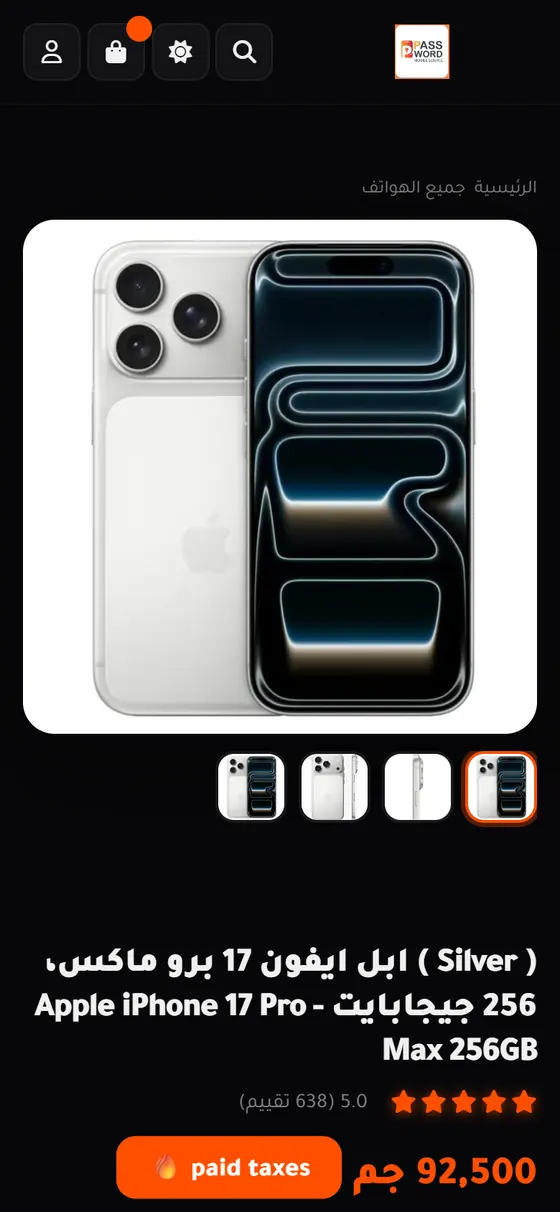

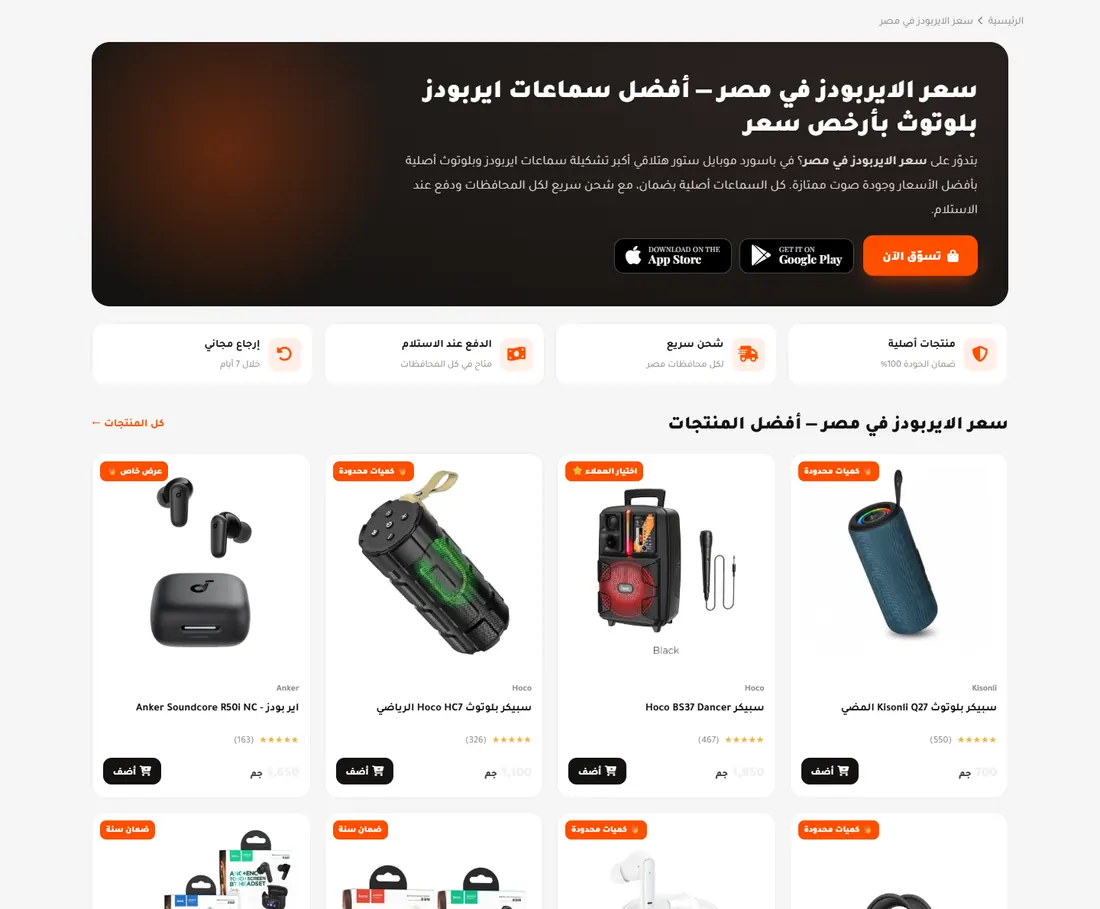
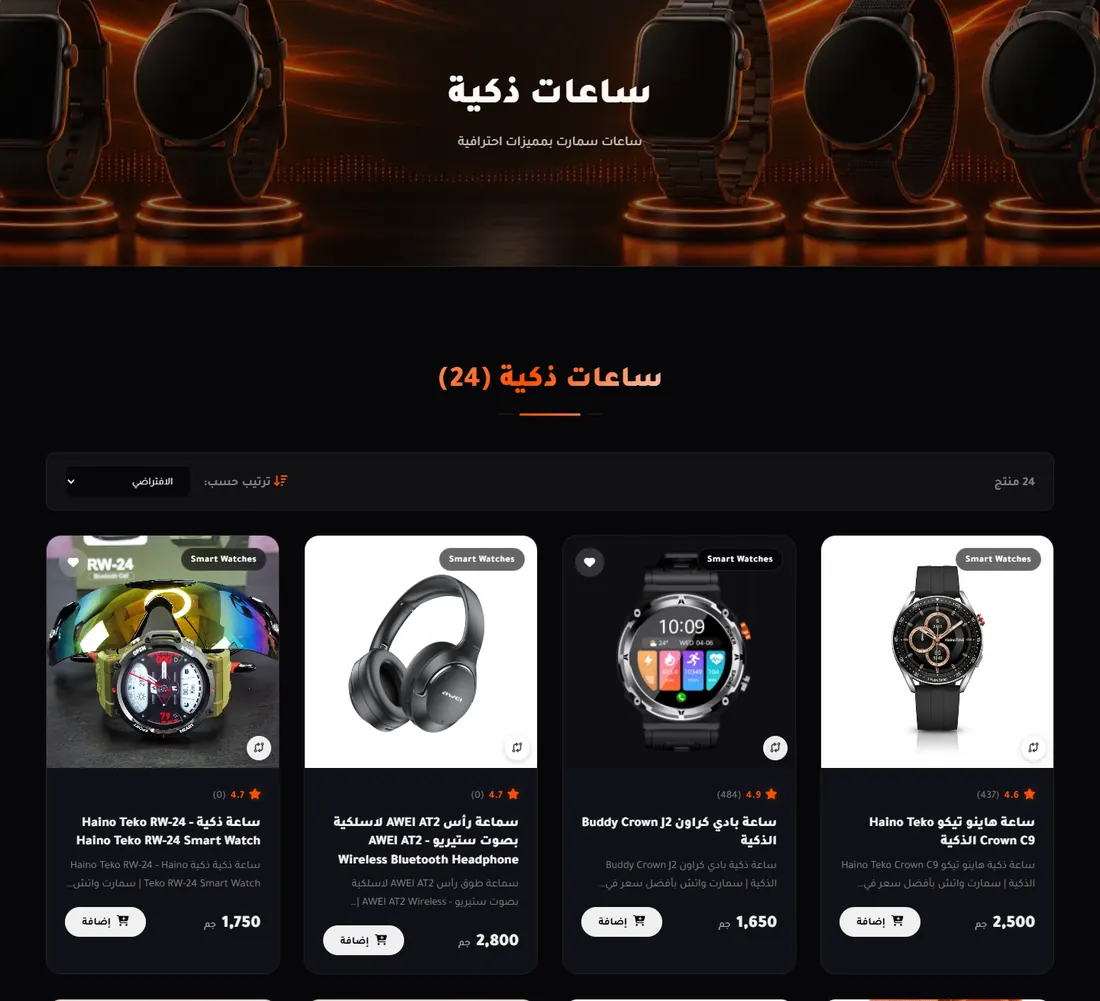

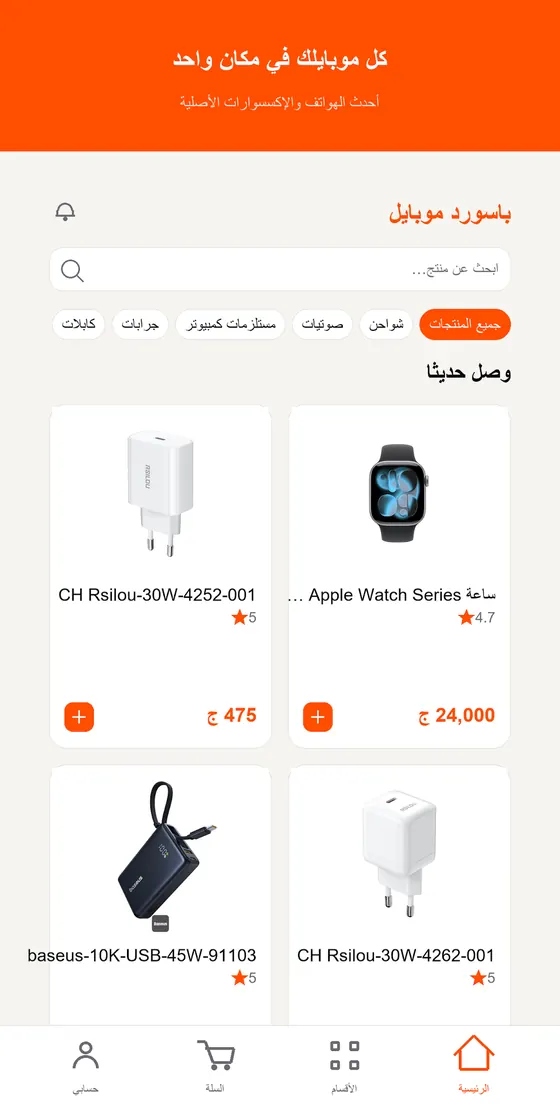
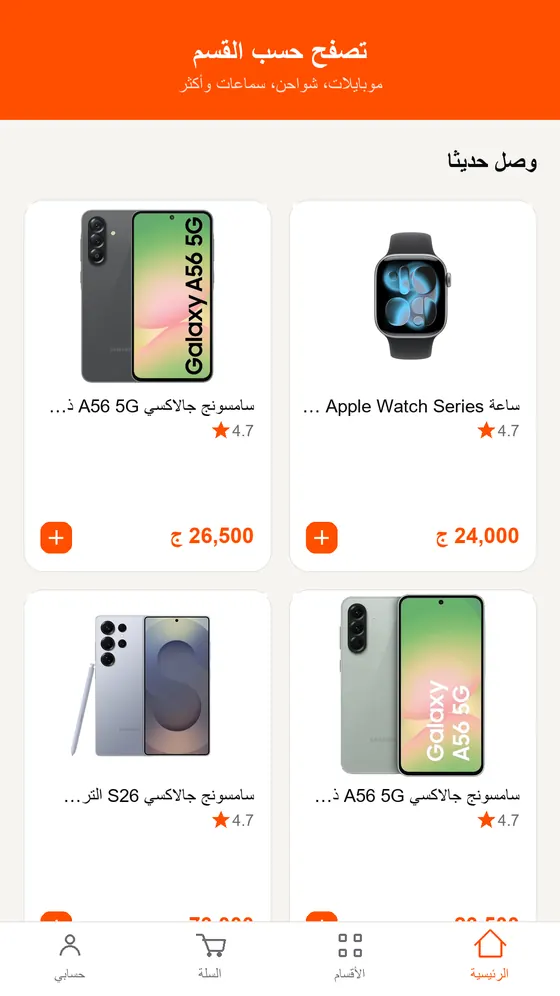
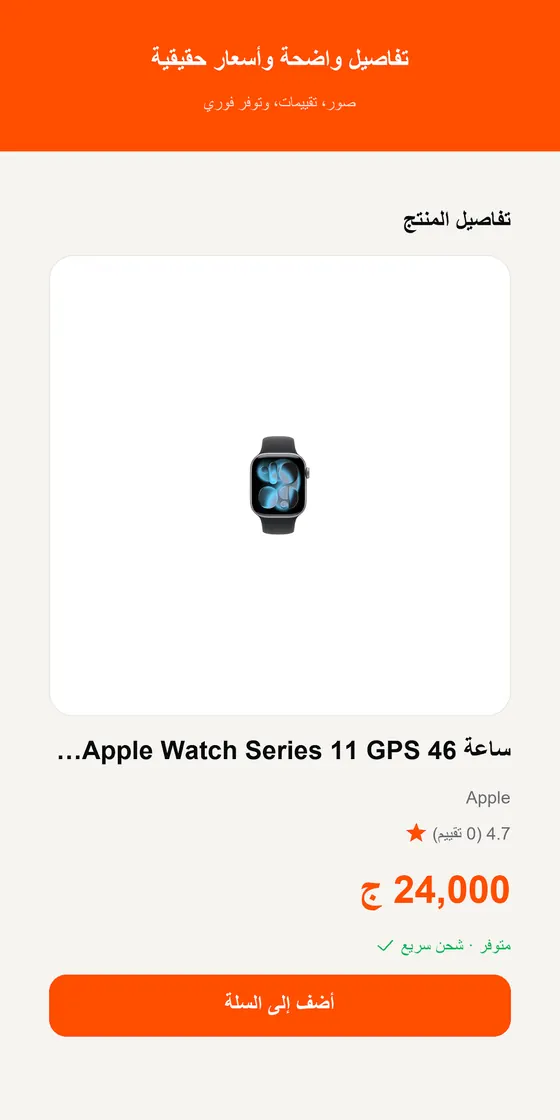
Younex Solutions designed and delivered the Password Mobile Store online shop as a complete e-commerce platform specialising in selling smartphones and original accessories, with a fast-responding Arabic interface, trusted online payment gateways, and an admin dashboard giving the shop team full control over the catalogue, orders and stock. The project was built to serve the shop's customers in Egypt and the Gulf and Arab markets, with a focus on browsing speed, clarity of the purchase journey, protection of customer data, and building trust that supports repeat ordering.
Project overview
The Password Mobile Store project is a clear model of what Younex Solutions means by the phrase "complete technical solutions". What was required was not merely a product display page but building a living online store dealing daily with dozens of products whose prices and quantities change, and with actual orders from customers expecting a shopping experience no less smooth than their experience at the major global stores. The team set out from an understanding of the nature of the business: selling smartphones and original accessories from brands such as Apple, Anker, Baseus, Hoco, Recci and Samsung, a sector characterised by fierce competition on price, by high sensitivity about the credibility of "genuine versus counterfeit", and by rapid change in stock as new models arrive continuously.
So the store was designed to be an operational platform before being a beautiful front. The structure was built on an organised relational database separating products from categories from orders from customers, so that the store can grow from hundreds of products to thousands without restructuring. The front end was connected to an admin dashboard allowing a new product to be added, its price or quantity updated, a limited offer to be launched, and the orders to be followed moment by moment. The result is a complete store serving three groups at once: the customer who searches and buys, the operations team that manages the catalogue and the orders, and the management that wants a clear picture of sales performance.
And it is important to understand the context this store works in: the mobile accessories sector is a "fast-moving" sector par excellence, since the customer most often buys on an immediate impulse — a charger that broke, an earphone that was lost, a new case for a recent model — and this means that any friction or slowness or vagueness in the information kills the sale immediately. In return, the average order value is relatively small, which makes raising the number of orders, the average basket and the repeat purchase rate the key to profitability, not raising the price of a single product. Younex designed every detail in the store from this economic equation: reducing friction, speeding up the decision, and encouraging repeat purchase through an experience that builds trust and keeps the customer in the store's orbit rather than jumping to a competitor. With that the project was not an exercise in building an interface but the engineering of a whole commercial model translated into screens, forms and buttons.
The client and the sector
Password Mobile Store is a shop specialising in smartphones and their original accessories, offering a broad range covering PD fast chargers, wall chargers and car chargers, wired and wireless earphones and Bluetooth speakers, smartwatches and power banks, and protective cases, cables, phone holders and camera accessories. The store relies on a clear core promise to the customer: 100% genuine products with a quality guarantee, with shipping covering various regions within a few days, a free returns policy within a defined period, and round-the-clock support over WhatsApp.
This business sits at the heart of the electronics e-retail sector, one of the fastest-growing sectors in the Arab and Gulf markets. The Arab consumer today — whether in Egypt, Saudi Arabia, the UAE or the rest of the Gulf states — has come to prefer buying accessories online for practical reasons: a clearer price, wider options, and easier comparison. But this sector carries a double challenge: on one hand, the customer's trust is fragile because of the spread of counterfeit products; and on the other hand, the profit margin on accessories is relatively small, which makes the store's efficiency, its speed and its ability to turn a visitor into a buyer decisive factors in the business's success. Younex's understanding of this equation is what guided the design and technical decisions from the start.
To that is added the nature of the competition in this sector, where a local store does not only compete with similar shops but also faces the giant platforms and open marketplaces. The specialist store's weapon here is not scale but specialism, trust, speed of service and the brand's closeness to its customer. So the essence of Password Mobile Store's message was bringing together the promise of "100% genuine" and a simple, fast purchase experience with close human support over WhatsApp — elements the giant platforms find hard to deliver with the same warmth. The site's task was to embody this distinction digitally: that the customer should feel from the first second that they are in a specialist store that understands their need, guarantees them authenticity, makes buying easy for them, and stands behind them after the sale. This clarity in defining the brand's position within a crowded sector is what made the content, design and functionality decisions all flow in one consistent direction.
The challenge
The challenge was not in building an online store that "works" but in building a store that convinces a hesitant customer to complete the purchase, gives the operations team daily management tools without complication, and preserves its speed and security as the catalogue and visitor traffic grow. The most prominent challenges came down to the following:
- Building a fast browsing experience on an Arab mobile network, since the vast majority of visitors to accessory stores browse from their phones and leave any slow page within seconds.
- Managing a huge and constantly changing catalogue: products coming in and going out, prices moving, limited quantities needing alerts, and "best seller" offers changing weekly.
- Establishing trust in "genuine" visually and functionally, to overcome the customer's fear of counterfeit products that stops many purchases.
- Connecting trusted online payment gateways with support for cash on delivery, because the Arab market still mixes the two methods, and any friction in the payment step means an abandoned cart.
- Designing a clear purchase journey from the product page to confirming the order, in the fewest steps, with order tracking that reassures the customer after payment.
- Providing a practical admin dashboard a non-technical team uses to manage everything without needing a developer for every change.
- Protecting customer data and payment operations, and securing the store against the common vulnerabilities in PHP stores.
And above these functional challenges there was a deeper strategic one: building a digital foundation serving not only the present moment but able to accommodate the store's ambition to grow. A store starting with hundreds of products may soon reach thousands, and may later need a mobile app, or connection to multiple shipping systems, or marketing campaigns linked to the catalogue. Any short-sighted solution would have turned into an obstacle after months. So Younex took into account from day one that what it is building is not a store for this stage but a scalable digital infrastructure growing with the business rather than constraining it.
The solution Younex delivered
Younex Solutions addressed these challenges with a complete engineering solution balancing the customer's experience, operational efficiency and security. The store was built on a PHP and MySQL base with a light and responsive front end, and every component was designed to serve a defined commercial goal. The following are the most prominent elements of the solution:
- A flexible catalogue structure dividing the products into categories and subcategories (chargers, audio, smart devices, protection, accessories) with filterable and sortable category pages, making it easier for the customer to reach what they want in the fewest clicks.
- A rich product page presenting multiple images, the price, the availability status, a "limited quantity" alert, the genuine and warranty badges, and prominent add-to-cart and buy-now buttons.
- An internal search and filtering engine allowing search by name or brand, and filtering by category and price, to shorten the distance between the intent to buy and completing it.
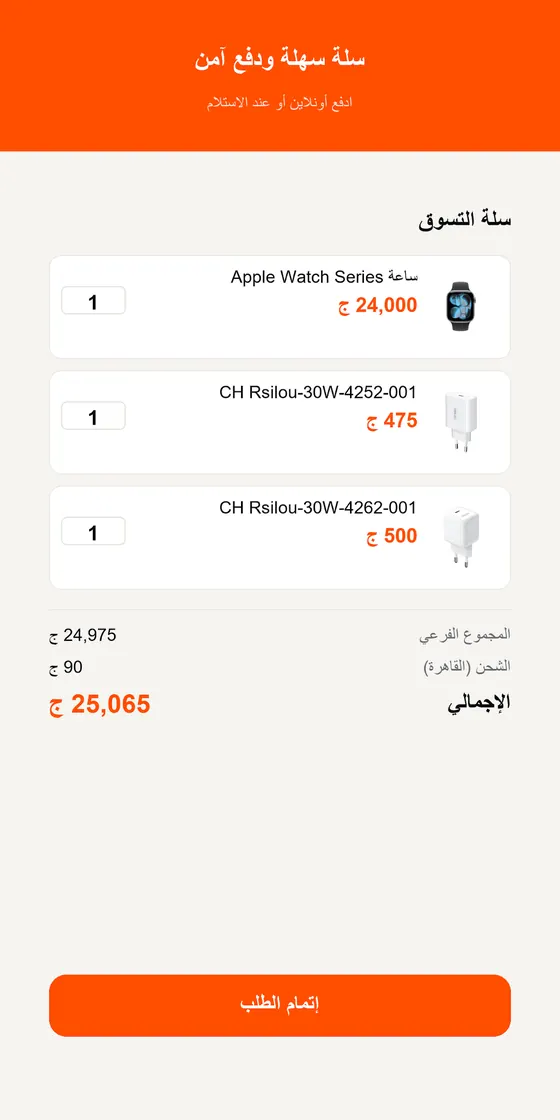
- A shopping cart and a simplified checkout page, with support for online payment gateways alongside cash on delivery, and automatic calculation of the shipping and the total.
- An order tracking system giving the customer an order number and a clear status after the purchase, and reducing the enquiry messages to support.
- A comprehensive admin dashboard for managing the products, categories, prices, quantities, orders and customers, with permissions and roles.
- Integration with WhatsApp for immediate support, and "best sellers", "latest phones" and "newsletter subscription" sections to increase engagement and the average basket value.
- A protection layer covering input validation, form protection, securing the dashboard and the payment, and setting the security headers.
What distinguishes Younex's approach is that it did not treat these elements as separate functions but wove them into one coherent experience. The interface's speed serves SEO, SEO brings visits, the visits meet a convincing product page, the product page leads to a simplified cart, the cart ends in flexible payment, and the payment is followed by tracking that builds the trust for the customer to return. This considered logical sequence — from the first appearance in search results through to repeat purchase — is what turns a set of features into a complete commercial system. And all of that was built on organised and maintainable code, so the store stays easy to develop in the future whenever new requirements or additional integrations arise.
Technical specification
| Element | Detail |
|---|---|
| Project type | A complete online store for smartphones and accessories |
| Server language | PHP |
| Database | MySQL — a relational structure for the products, categories, orders and customers |
| Front end | HTML5, CSS3 and JavaScript — a mobile-first responsive design |
| Language and direction | Arabic RTL with English support |
| Payment gateways | Online card payment + digital wallets + cash on delivery |
| Dashboard | An admin panel for the products, orders, stock and customers with permissions |
| Search engine optimisation | Friendly URLs, meta tags, structured product data, a sitemap |
| Performance | Asset compression, lazy loading of images, page caching, query optimisation |
| Security | Input validation, CSRF protection, security headers, securing the payments |
| Integrations | WhatsApp for support, a newsletter, promotion of the iOS and Android app |
| Responsiveness | Works efficiently on mobile, tablet and desktop |
The features delivered
- An organised product catalogue with categories and subcategories with fast filtering and sorting within each category.
- A rich product page with multiple images, the genuine and warranty badges and limited quantity alerts.
- A cart and a simplified checkout in the fewest possible steps with automatic calculation of the shipping and the total.
- Multiple payment gateways bringing together online payment and cash on delivery to cover the Arab market's preferences.
- An order tracking system giving the customer a clear status after the purchase and reducing enquiries.
- Dynamic marketing sections: "best sellers", "latest phones", limited offers, and a newsletter.
- WhatsApp integration for direct and immediate round-the-clock support raising trust and the conversion rate.
- An admin dashboard giving the shop team full control over the catalogue, prices, stock and orders.
How the project ran
- Discovery and business analysis: sessions to understand the nature of the products, the categories, the target customer's behaviour, the payment and shipping preferences, and the operations team's priorities.
- Information architecture: designing the category tree, and the user journey map from the home page to confirming the order, and defining the fields needed for each product.
- User interface design: building a responsive Arabic design system focusing on the clarity of the product, the price and the purchase buttons, with priority for mobile.
- Back-end development: building the MySQL database and the PHP logic for the catalogue, the cart and the orders, with an admin dashboard.
- Connecting the payment and shipping gateways: integrating online payment and cash on delivery, calculating the shipping, and testing the payment scenarios.
- Performance and SEO optimisation: asset compression, lazy loading, friendly URLs, structured product data, and a sitemap.
- Security audit: reviewing the inputs, and protecting the forms, the payment and the dashboard, and setting the security headers.
- Testing and launch: testing the complete purchase journey on multiple devices, then launching with follow-up and training for the team on the dashboard.
User experience and design
The user experience was built around a single rule: every second of delay or extra step means a lost customer. So the design came out responsive with mobile priority, with a clean Arabic interface placing the product, the price and the purchase button at the focus of attention. Clear product grids were adopted with star ratings and high-quality images, with a colour contrast bringing out the main action buttons without visual noise. The product page was designed to answer all the customer's questions before they ask them: is the product genuine? What is the warranty? Is it available? What is the price? How do I buy? And the trust badges (genuine, warranty, free returns, WhatsApp support) were placed in positions supporting the purchase decision at the moment of hesitation.
At the visual level, a calm colour identity was adopted allowing the products to take the lead, since the hero in an accessories store is the product itself and not the decoration around it. White space and considered contrast were used to direct the eye towards what matters: the image, the price, the purchase button. Care was also taken that the Arabic text should be clear and legible on various screen sizes, and that the icons should be familiar, dispensing with the need for explanation. These visual decisions, despite their apparent simplicity, are the product of an understanding of the Arab shopper's behaviour, who wants to reach their decision with the least possible mental effort.
At the level of the purchase journey, the steps were reduced to a minimum, since the cart and the checkout are designed to reduce friction, with support for cash on delivery for those who prefer it and online payment for those who want speed. After the order the customer gets an immediate confirmation and a tracking number, which turns post-payment anxiety into reassurance. These small details — loading speed, clarity of the buttons, transparency of the price, ease of tracking — are what make the difference between a store a visitor browses and leaves, and a store they trust and return to.
The psychological side of buying online was also observed in the design. A customer buying for the first time from a store they do not know carries a degree of caution, so signals of reassurance were distributed along the journey: from the genuine and warranty badges on the product page, to the clarity of the returns and shipping policy, to the support channel over WhatsApp appearing within reach at the moment of any hesitation. And the "limited quantity" and "best seller" alerts were not placed as decoration but as gentle persuasion tools pushing the decision without excessive pressure. As for browsing, the category pages were designed to reduce the "burden of choice": clear filtering and sorting helping the customer narrow the options quickly instead of drowning among dozens of similar products. The outcome is an experience that does not settle for being easy to use but is deliberately designed to turn a hesitant visitor into a reassured buyer, and then into a returning customer.
Results and impact
Password Mobile Store came out with an e-commerce platform ready for growth, bringing together a fast interface serving the customer and management tools serving the operations team. The store can now add products, update prices and quantities and launch offers within minutes without technical intervention, which raised the speed of response to the market. And the simplified purchase journey, the multiple payment gateways and the trust badges provided a strong foundation for raising the rate at which a visitor converts into a buyer, and reducing abandoned carts. The WhatsApp integration and the tracking system also reduced the pressure on support, and improved the after-sales experience.
More importantly, the value Younex delivered was not momentary but cumulative. The scalable structure means the store can grow with the business's growth without hitting a technical ceiling, and can add categories, integrations and new marketing features on top of the same foundation. And the dashboard giving the team complete independence means a continuing saving in time and cost, since every change no longer requires a developer. As for the performance and SEO improvements, they translate over time into more organic visits and a lower acquisition cost. In this sense, Younex Solutions did not hand over a store that works today alone, but a digital asset serving Password Mobile Store's ambition to expand within both the Egyptian and Gulf markets over the long term, and laying a solid foundation for any coming stage of growth whether through a mobile app, widening the range, or entering new markets.
Frequently asked questions
What kind of project did Younex deliver for Password Mobile Store?
A complete online store specialising in smartphones and original accessories, with a responsive Arabic interface, payment gateways, and an admin dashboard for managing the catalogue, orders and stock.
What technologies were used in building the store?
The store was built on PHP and MySQL in the back end, with a mobile-first responsive front end in HTML5, CSS3 and JavaScript, optimised for search engines, performance and security.
Does the store support online payment and cash on delivery?
Yes. Online payment gateways for cards and digital wallets were connected alongside the cash on delivery option, to cover customers' preferences in the Arab and Gulf markets.
How does the shop team manage the products and orders?
Through an easy admin dashboard allowing products, categories, prices and quantities to be added and edited, and the orders, their statuses and the customer data to be followed, without needing programming experience.
Is the store responsive on phones?
Yes. It was designed with mobile priority and works efficiently on mobile, tablet and desktop, with high loading speed to reduce the visitor bounce rate.
Does the store serve the Gulf market?
Yes. It was built to serve Arab customers in various countries with a focus on the Gulf market, with an Arabic interface and flexible, scalable payment and shipping options.
Can the store be developed in the future?
Certainly. The structure is designed for expansion, and new categories, additional shipping and payment integrations, a mobile app and marketing features can be added without rebuilding the foundation.