


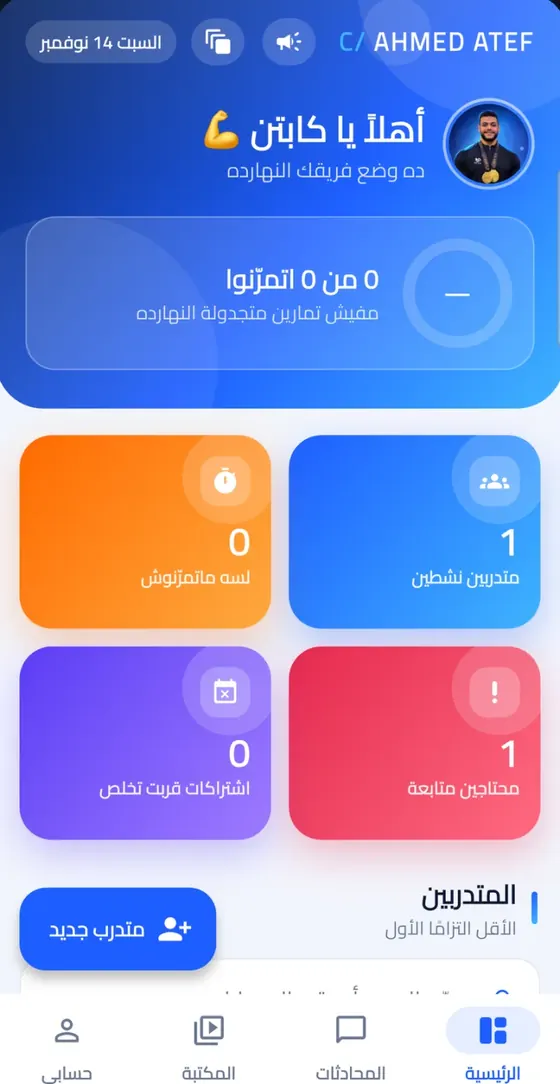
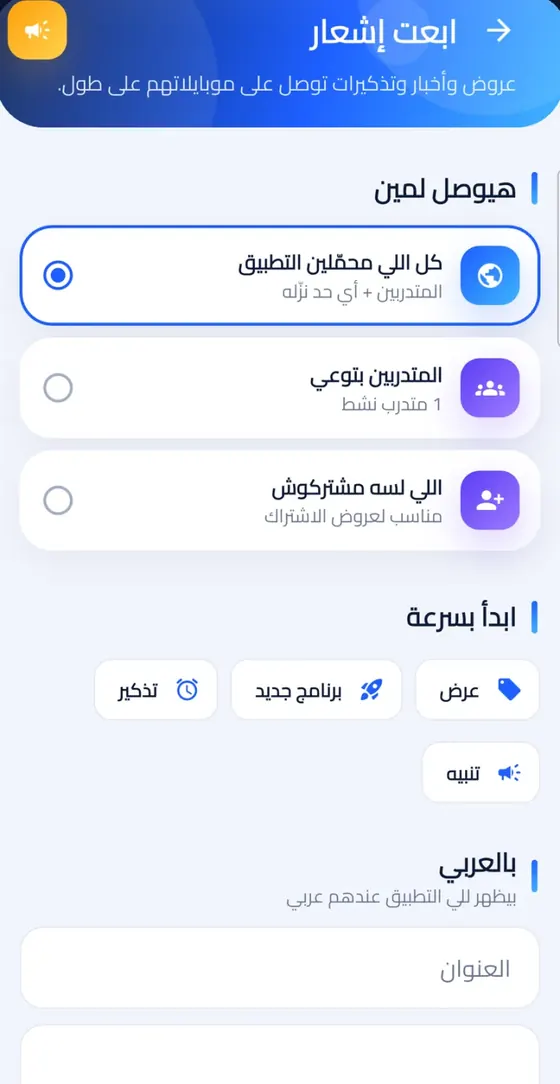
Younex built the website of Coach Ahmed Atef (Captain Ahmed Atef) at ahmedatef.fit: the site of a fitness and bodybuilding coach who trains his clients fully online, in Arabic at the main address and in English at /en. It has a page for each of the six services, a page presenting the coaching app, an exercise video library, a blog with 13 articles in both languages, "personal trainer" pages for Egypt, Saudi Arabia, the UAE, Kuwait and Qatar, a coaching request that reaches the captain through the form and WhatsApp, and an admin dashboard he uses to edit everything from his phone. We also built the same captain an Android app, which has its own project page, and the website points to its Google Play listing.
Overview
The coaching itself happens inside the app: the training program, the meal plan, the demo videos, chat and calls, and InBody readings. So the website is not meant to do the app's job. It has three jobs: tell people who the captain is and how the coaching works, show up on Google when someone searches for his name or for "online coach" or "personal trainer" in their country, and turn a convinced visitor into a coaching request that reaches the captain with all their details.
Without a website, someone searching Google for a coach would not find a page in the captain's name explaining what he offers, or answering questions such as: do I need to have trained before? Can I train at home? Is the app on iPhone? Can I sign up while living outside Egypt?
About the client and the sector
Ahmed Atef is an Egyptian fitness and bodybuilding coach, known to people as "Captain Ahmed Atef", with an online coaching brand called AHMED ATEF. All his work is remote: a trainee sends a request, the captain runs a starting assessment of their body, goal, food and schedule, then the program and meal plan arrive in the app, and the follow up continues from there in Arabic or English. The About page presents his career at the gyms he has worked in and his sporting achievements as he presents them.
There are six services: full online coaching, fat loss and cutting, muscle building, nutrition plans, gym workout programs, and InBody and progress tracking. The audience is in Egypt and the Gulf, which means two languages, different food and different working hours.
The online coaching market is crowded, and many coaches rely on Instagram and TikTok alone. Anyone searching Google for "personal trainer" or "meal plan" runs into gyms and generic articles, and a coach without a page that explains his work leaves that space to others.
The challenge
The first challenge is that the real product is an app. Visitors need to understand what they will get before they download or pay, and ordinary screenshots go out of date with the first update and are hard to read on a small phone.
The second challenge is that search is split into different kinds. Some people type the captain's name in more than one spelling, some search for a service such as "fat loss", "InBody" or "gym workout plan", and some search for a coach in their country, such as "personal trainer Saudi Arabia" or "personal trainer dubai". Each kind needs a page that answers it specifically.
The third challenge: requests. This audience is used to WhatsApp. If the site only has a form, many people will leave it. If it only has a WhatsApp button, the request gets lost in the chat without being recorded anywhere, and the captain will not know where it came from.
The fourth challenge is that the captain runs the site himself, from his phone. Change a sentence, swap a photo, upload a video, check the requests, without a developer.
And the fifth challenge was the look. A coach's site needs a sense of movement, and heavy animation slows the page down on phones.
The solution
We started with a keyword map. Every page on the site has one primary keyword in Arabic and one in English, with supporting keywords, and the figures come from Google Ads Keyword Planner data. The home page targets the captain's name, the About page "bodybuilding coach", and each service its own keyword, such as "fat loss" and "InBody". The Egypt page targets the Arabic for "gym captain", the Saudi page the Arabic for "sports trainer", and the UAE page targets "personal trainer dubai" in English. The map lives inside the admin dashboard so no new page takes another page's keyword.
The site is written in PHP with no framework, and all the content lives in JSON files with no database. Arabic is the main version at the root address and English is at /en, and every page has hreflang tags linking it to its other version. The Arabic copy was written in simple Standard Arabic that reads easily in Egypt and the Gulf, and the English was written on its own, not machine-translated.
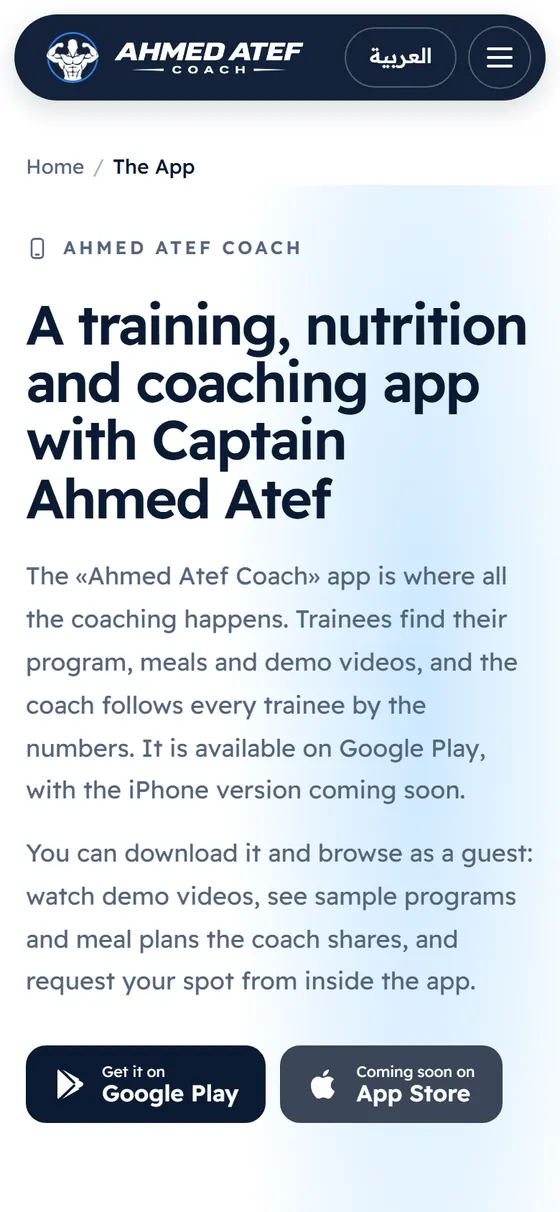
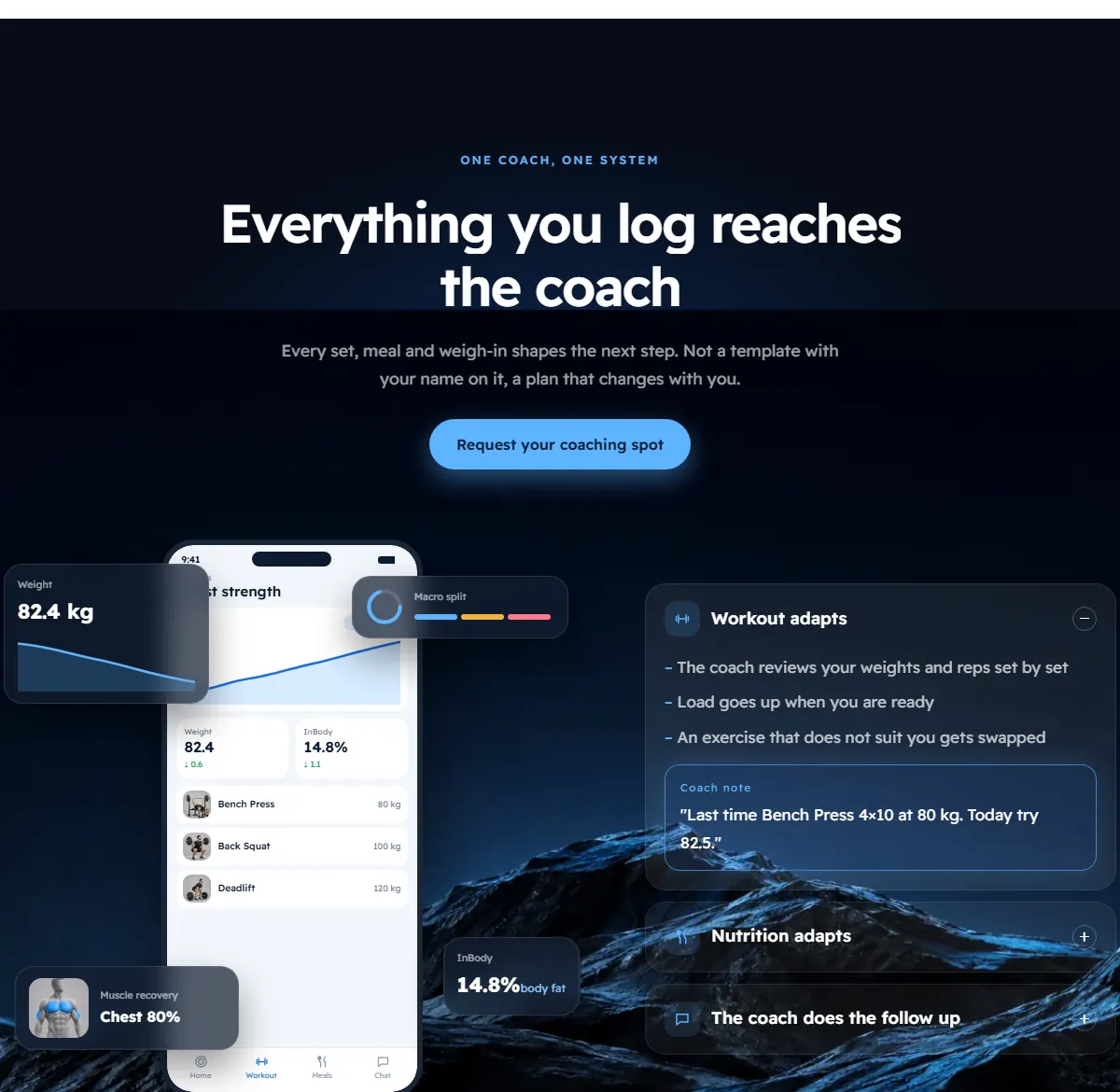
The app screens on the site are not images. They were built in HTML and CSS in the shape of a phone: the day's meal plan with calories, protein, carbs and fat, today's workout with sets and reps, a progress screen with weight, an InBody reading and best lifts, and a chat screen with the captain. So the text on them is clear on any screen, can be edited from the admin dashboard, and appears in the page's language.
For requests we built one path that combines the form and WhatsApp. The visitor fills in their details, the request is saved in the admin dashboard, and then a WhatsApp button appears that opens the chat with a ready message containing their name, goal and chosen service. So the request is recorded, and the visitor carries on where they are comfortable.
For answer engines we wrote an llms.txt file that sums up the captain, his services, the site's pages, the articles and the FAQ in Arabic and English, and an llms-full.txt file with the full text of the About page, the services and every article. The robots file allows crawlers such as GPTBot, ClaudeBot, PerplexityBot and Google-Extended by name, and blocks only the admin dashboard. The site also has an IndexNow key, so any new page can be reported to the search engines that support it as soon as it is published.
Technical specifications
| Item | Details |
|---|---|
| Project type | A bilingual website for an online fitness and bodybuilding coach, with a full admin dashboard and a link to the coaching app |
| Build | Custom PHP with no framework, content in JSON files with no database, and plain JavaScript with no UI framework |
| Pages | Home, About, Services and six service pages, the app, the exercise library, the blog and 13 articles, the author page, the FAQ, the coaching request, the personal trainer page and five country pages, and three legal pages |
| Languages | Arabic at the main address and English at /en, with hreflang for both languages plus x-default, and a sitemap that lists the other-language link for every page |
| Structured data | Person, Organization, WebSite and WebPage on every page; Service for the service and country pages; Article for the articles; FAQPage; BreadcrumbList; ProfilePage for the About and author pages; MobileApplication for the app page; and VideoObject for the exercise videos |
| Motion | GSAP, ScrollTrigger and Lenis, loaded after the first interaction or once the page is idle, switched off when the device has reduced motion turned on, and smooth scrolling disabled on touch screens |
| Typeface | Readex Pro for Arabic and English, self-hosted, with a fallback font tuned to the same metrics so the text does not jump while it loads |
| Sharing | A 1200×630 share image for every page with its own title in its own language, generated on the server and rebuilt when the title changes |
| Answer engines | llms.txt and llms-full.txt in two languages, and a robots.txt that allows the ChatGPT, Claude, Perplexity, Google-Extended, Applebot-Extended and other crawlers by name |
| Indexing | A sitemap with 76 links, a canonical on every page, an IndexNow key, and empty pages such as the reviews page kept noindex until content is published on them |
| Admin dashboard | An editor for every text on the site, a media library that replaces an image in place, a video library, requests with statuses and CSV export, collections, SEO titles and descriptions, the keyword map, and an activity log |
| Security | A token on every form, protection against repeated submissions, a spam filter, a CSP with a nonce, and a full set of security headers |
Key features
A home page that shows the app before the download
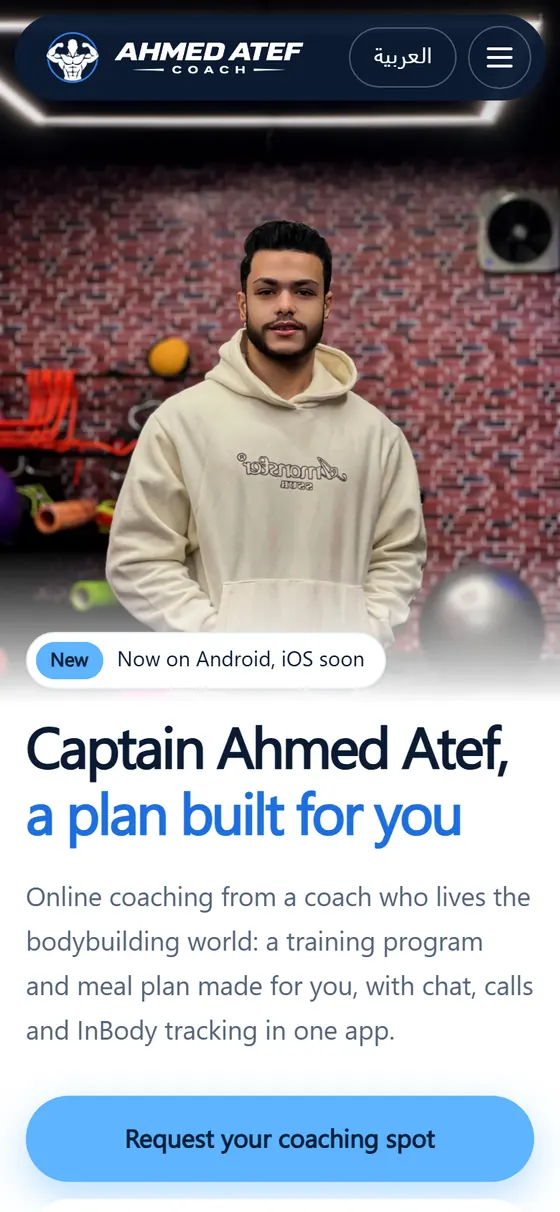
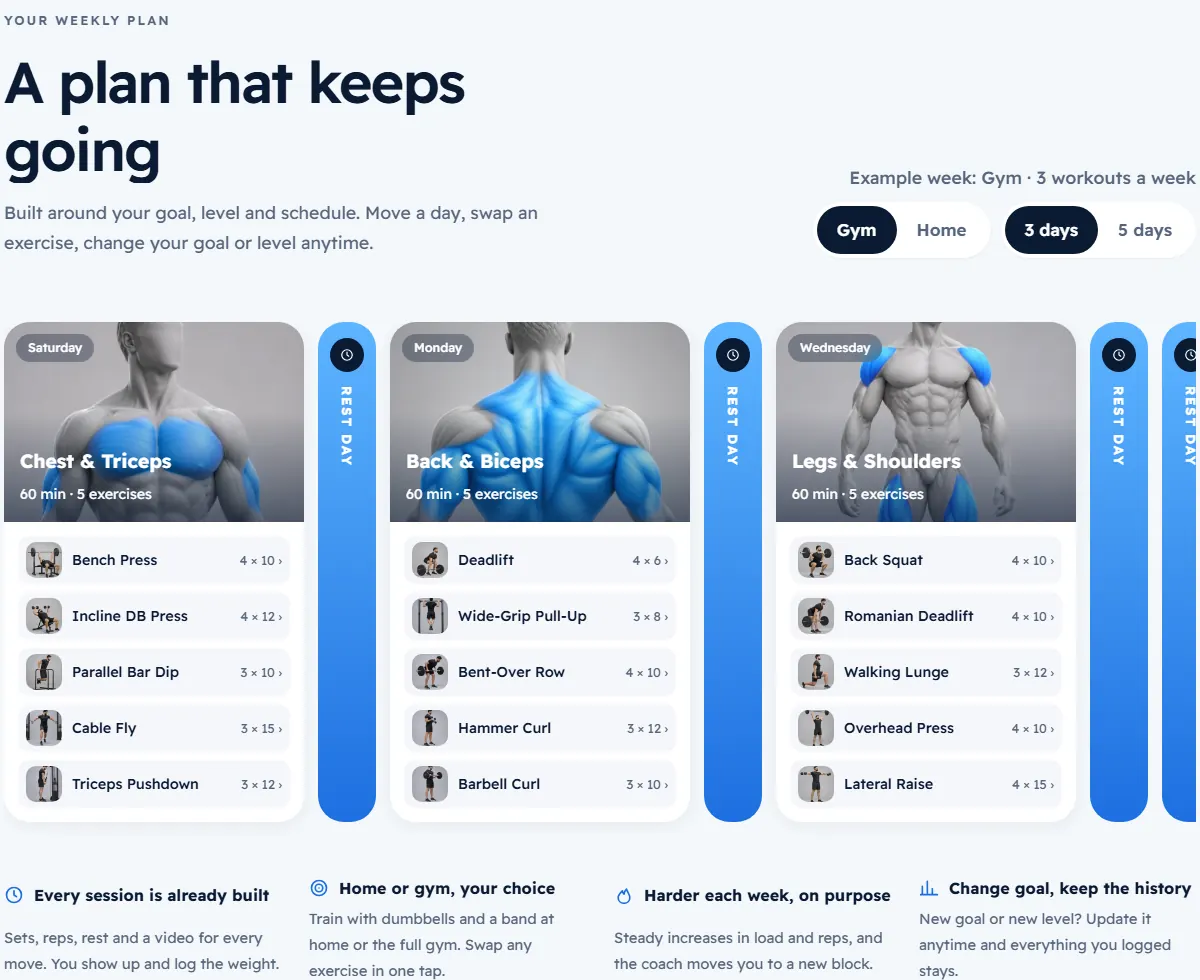
The first screen has the captain's name, one sentence summing up the service, the coaching request button, a "Pick your goal" button, the Google Play and App Store badges, and next to them the app screens built in code. Then the "A plan that keeps going" section shows a full training week, with two toggles that switch between gym and home and between three and five days a week, followed by a tour of the app in four tabs: Home, Workout, Nutrition and Progress.
"Pick your goal" opens the form ready to go
The "See your plan before you pay" section has four buttons: fat loss and cutting, muscle building, general fitness and health, and nutrition plan only. Each button opens the coaching request page with that goal already selected.
A page for each of the six services
Every service has a page in the same order: an introduction that explains the problem, a "What is included" list, the process step by step, explanatory sections, and an FAQ with clear answers recorded in FAQPage data. The fat loss page, for example, explains why your weight stalls while you are still sticking to the diet and why the scale is not everything, and links to the fat loss meal plan article.
"Personal trainer" pages for five countries
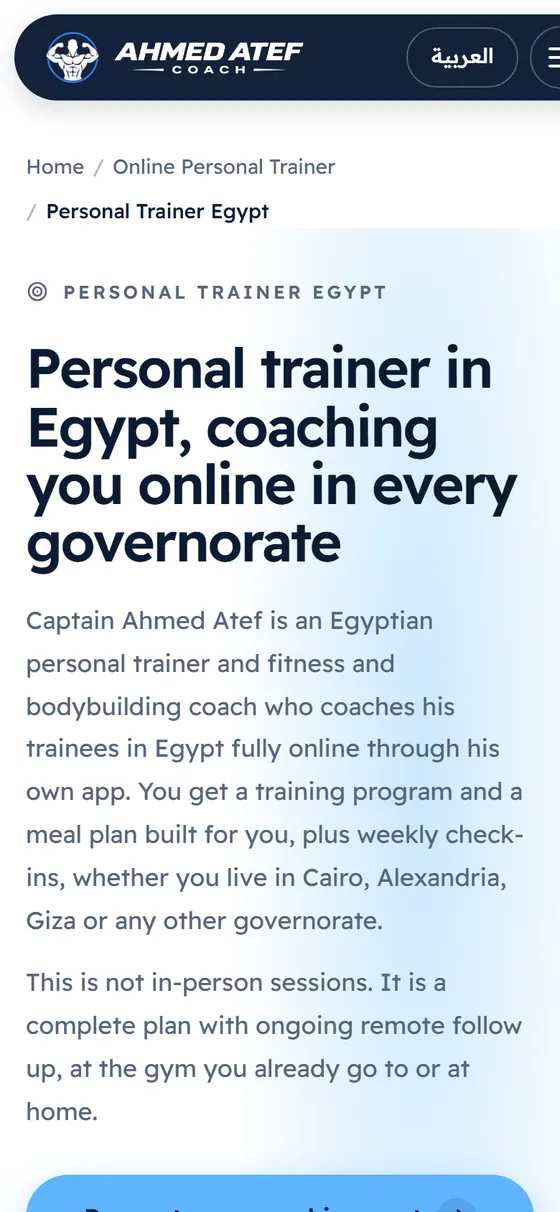
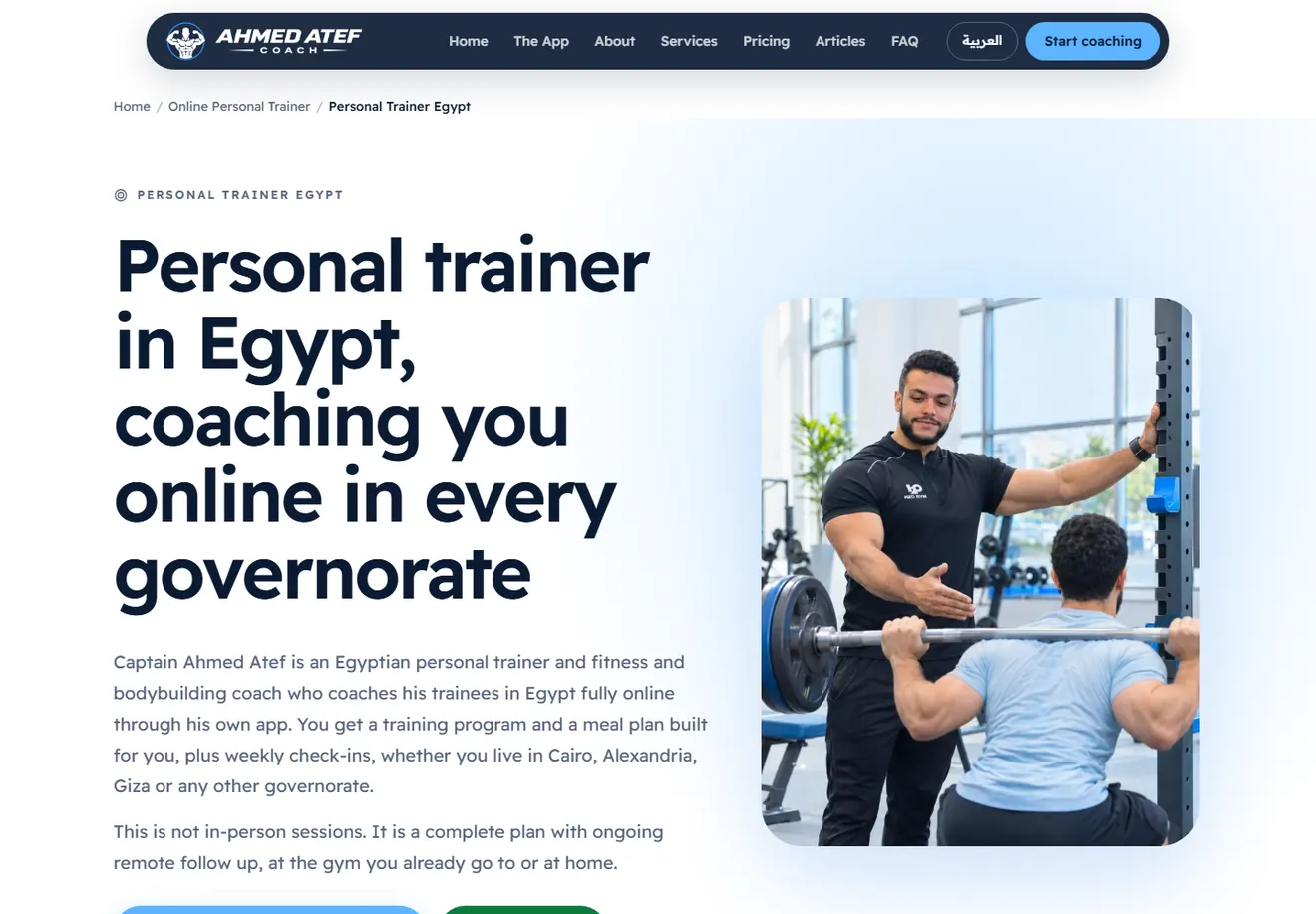
A general page for the online personal trainer, and under it a page each for Egypt, Saudi Arabia, the UAE, Kuwait and Qatar. Each page is written for its country: the Saudi page talks about shifting work hours and adjusting the plan for Ramadan and travel, and the UAE page mentions Dubai, Abu Dhabi, Sharjah and Al Ain. They include a comparison between an online trainer and a trainer at the gym. Most importantly, every page states plainly that the captain does not offer in-person sessions in that country.
A blog of 13 articles in two languages
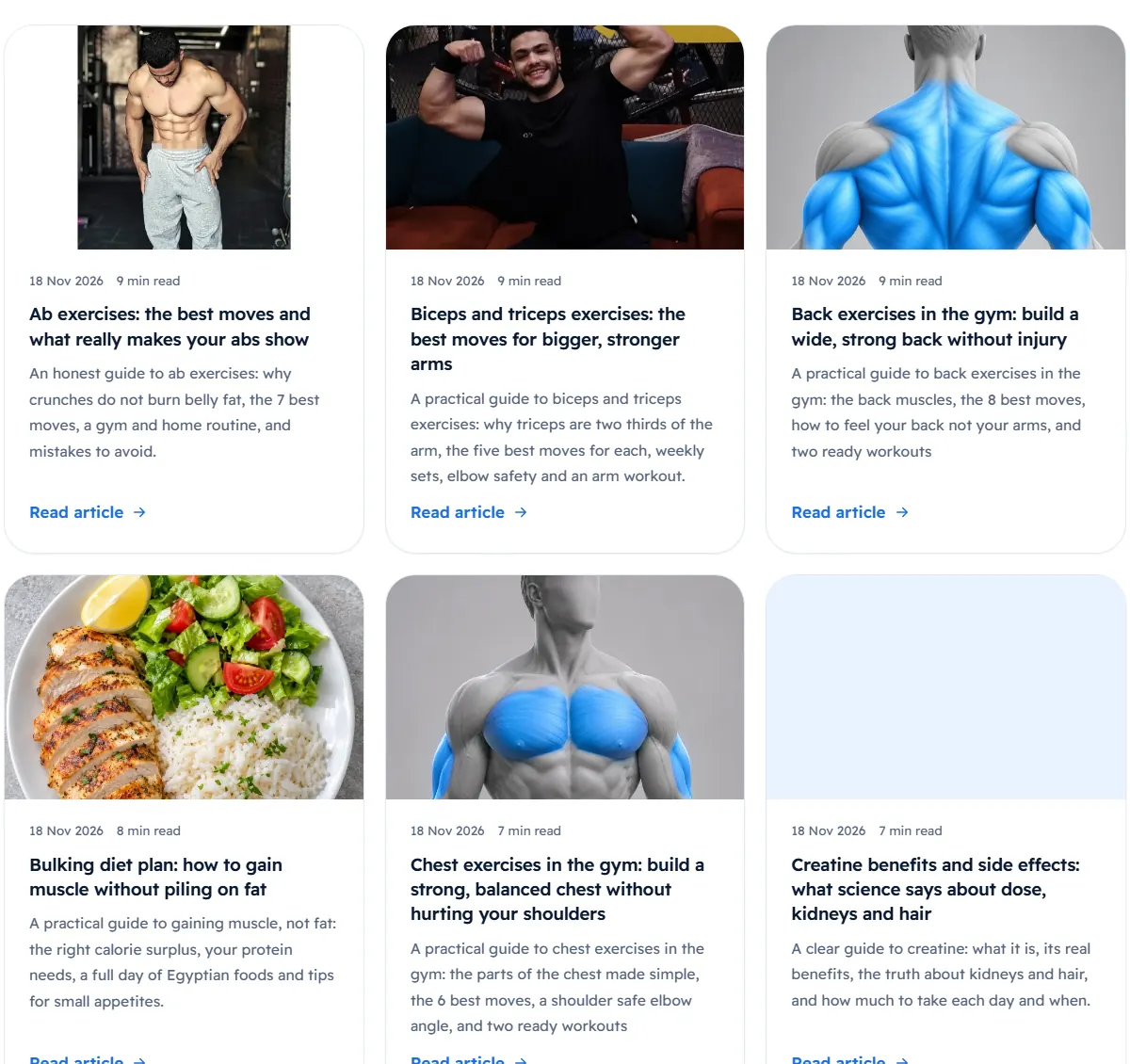
The articles cover training and food: exercises for each muscle group, calories, fat loss and bulking meal plans, weight loss plateaus, whey protein, creatine and beginner gym workouts. Every article carries the author's name, the reading time, the publish date and last-updated date, a table of contents, an FAQ at the end, share buttons for WhatsApp, Facebook and copying the link, and an author box that links to his page. Inside the text there are links to the relevant service.
An exercise library that updates from the app
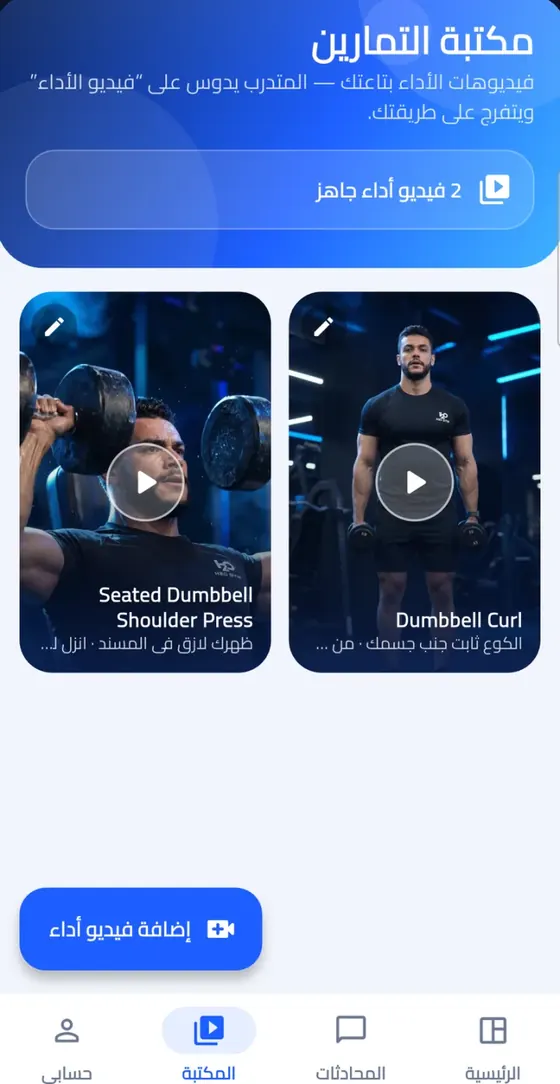
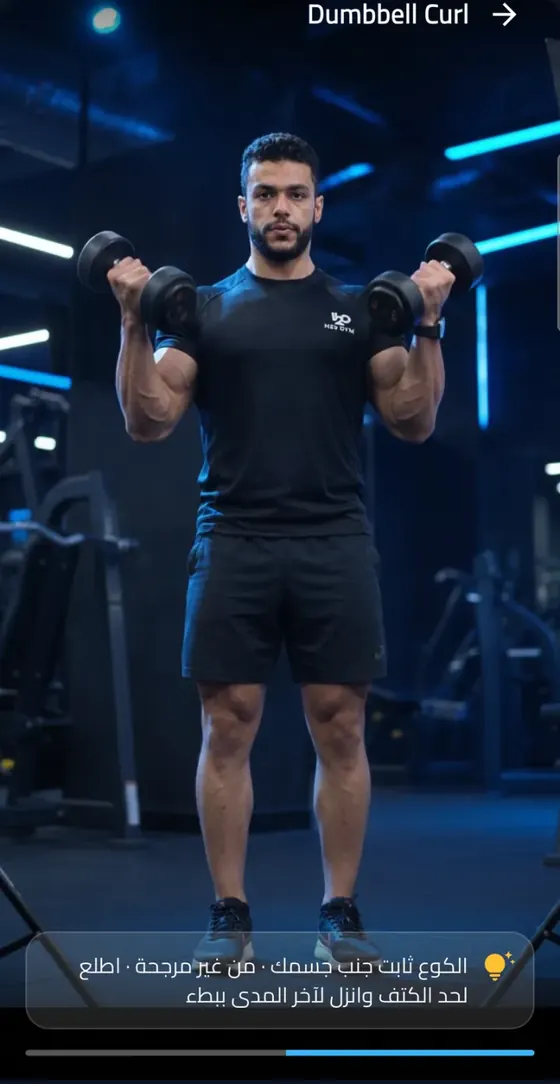
The demo videos on the exercise library page and on the home page are not uploaded to the site separately. The site pulls them from the app's own library and keeps a temporary copy, so any video the captain adds to the app shows up on the site with no extra work. Each video sits next to the captain's form cue, such as "keep your elbows fixed at your sides, no swinging", and that cue can be edited in Arabic and English from the admin dashboard. The videos are recorded in VideoObject data.
The coaching request: a form, then WhatsApp
The form is short: name, WhatsApp number, goal, service or "not sure, let the coach suggest", optional age and an optional note. The number is accepted in Arabic or Western digits, and an Egyptian number starting with 01 gets the country code added automatically. After sending, the request is saved, and the thank-you page has a WhatsApp button with a message carrying the request details; on phones WhatsApp opens on its own after a few seconds. The form records the page the visitor came from, and it has bot protection and a filter that drops spam messages.
A share image for every page in its own language
When someone sends a page link on WhatsApp or Facebook, a 1200×630 image appears with the captain's photo and that page's own title, rather than one image for the whole site. The image is generated on the server in the page's language, the Arabic letters join correctly, and if the page title changes a new image is produced automatically.
An admin dashboard the captain runs from his phone
The captain opens the dashboard in his phone's browser, and its tables turn into cards. From it he edits any visible text on the site in Arabic and English, with the texts grouped by page and a preview link next to them. He replaces any image in place and restores the old one if he wants, and images are converted to WebP in two sizes with alt text in both languages. He uploads long videos in chunks, and the server converts them to a light MP4 with a poster image. He edits the services, country pages and articles with a visual editor, and the SEO title and description of every page. Requests have their own page with statuses: new, contacted, subscribed and closed, plus CSV export. And there is an activity log.
Implementation stages
- Research: we gathered search terms about coaching, training, nutrition and personal trainers in Arabic and English, in Egypt and the Gulf countries.
- Page map: we tied every page to one primary keyword in each language, so no two pages compete for the same term.
- Content: we wrote the Arabic copy in simple Standard Arabic and wrote the English on its own, from the home page through to the service and country pages.
- Design: a light home page with dark sections, the captain's photos, and app screens built in code.
- Build: custom PHP with content in JSON files, a two-language system that renders every page in Arabic and English from the same template, and pulling the exercise videos from the app.
- Requests: the coaching request form, saving the request, the ready WhatsApp message, and spam protection.
- Blog: 13 articles in two languages, with a table of contents, an FAQ and links to the services.
- Technical SEO: canonical and hreflang, a sitemap with other-language links, structured data, a share image for every page, llms.txt and IndexNow.
- Admin dashboard: the text editor, the image and video libraries, requests and collections, then fitting it to a phone screen.
- Launch: the site was opened to search engines on 18 November 2026, and the country pages and admin dashboard improvements were added after that.
User experience
A visitor arriving from Google on a phone sees the captain's name, the service sentence and two clear buttons on the first screen. The menu holds Home, The App, About, Services, Articles and FAQ, a "Start coaching" button, and a language button that goes to the same page in the other language rather than to the home page. On phones the menu slides in from the side, and at its end sit the coaching request, contact on WhatsApp and the app download. There are no pop-ups interrupting the reading.
Someone still deciding finds the "Your roadmap to real results" section, which explains the start in four steps: send a request, the starting assessment, get the app, and start and check in. Someone with a question finds the FAQ on the home page and on its own page, grouped by service. And someone who wants to talk to the captain right away finds a WhatsApp button on almost every page, with a message that says which page they came from.
On phones the site is deliberately lighter than on desktop: lighter shadows, no blur effects, a ticker that pauses when it leaves the screen, and smooth scrolling switched off on touch screens so scrolling stays natural. The motion libraries load after the page appears. And if the visitor has reduced motion turned on in their device, the site shows everything static.
The app page says plainly that the app is on Android now and the iPhone version is coming soon.
Results and impact
The site is live at ahmedatef.fit in Arabic and English, its sitemap holds 76 links, meaning 38 pages in two versions, and all of them return 200. Every page has its own title, description, share image and structured data.
We are not publishing traffic, ranking or request figures here; that is the captain's data. What we can say is that the captain now has one official source that speaks for him in two languages, and every coaching request is recorded in one place with its status instead of getting lost in the chat. And he edits the site himself from his phone without waiting for anyone.
One decision was made on purpose: the trainee reviews page and the results page are kept out of Google until real stories are published on them with their owners' consent. The admin dashboard reminds the captain about this on its home screen.
The website and the app now work together: the site introduces the captain and brings in the request, the app is where the coaching itself happens, and the exercise videos flow from the app to the site on their own.
Frequently asked questions
What is the Coach Ahmed Atef website?
It is the website of a fitness and bodybuilding coach who trains online, built by Younex at ahmedatef.fit. It covers the six services, the app, the exercise library, 13 articles and pages for five countries, in two languages.
Does the site sell the subscription online?
No. The site has no payment. The visitor sends a coaching request through the form or messages the captain on WhatsApp, and the captain replies with the details.
How does a coaching request reach the captain?
The request is saved in the admin dashboard with the status "new", and at the same time the visitor opens WhatsApp with a ready message containing their name, goal and service. The captain changes its status when he talks to them or when they subscribe.
How does the website relate to the captain's app?
Both are for the same captain and both are Younex work. The website covers the introduction, search and the coaching request, and the Android app holds the program, the meals, the videos, the chat and the InBody readings. The site links to the app's Google Play listing and shows the exercise videos from the app's own library.
Why is Arabic at the main address and English at /en?
Because the site is aimed mainly at an Arabic-speaking audience in Egypt and the Gulf. So Arabic is the main version, and English is a full version at /en for people who search in English. Every page is linked to its other version with hreflang tags.
How does the captain edit the site's content?
From an admin dashboard that works in his phone's browser. He edits the texts, images, videos, articles and SEO from it without touching the code.
What are the country personal trainer pages for?
People search for a coach in their own country, such as "personal trainer Saudi Arabia" or "personal trainer dubai". So each country has a page written for its circumstances, food and cities, and it says plainly that the coaching is online and there are no in-person sessions.
What is the llms.txt file for?
It is a text file that sums up the captain, his services, the site's pages and his articles for tools such as ChatGPT and Perplexity. When those tools are asked about the captain or about an online coach, they have an official source to draw on instead of guessing.