

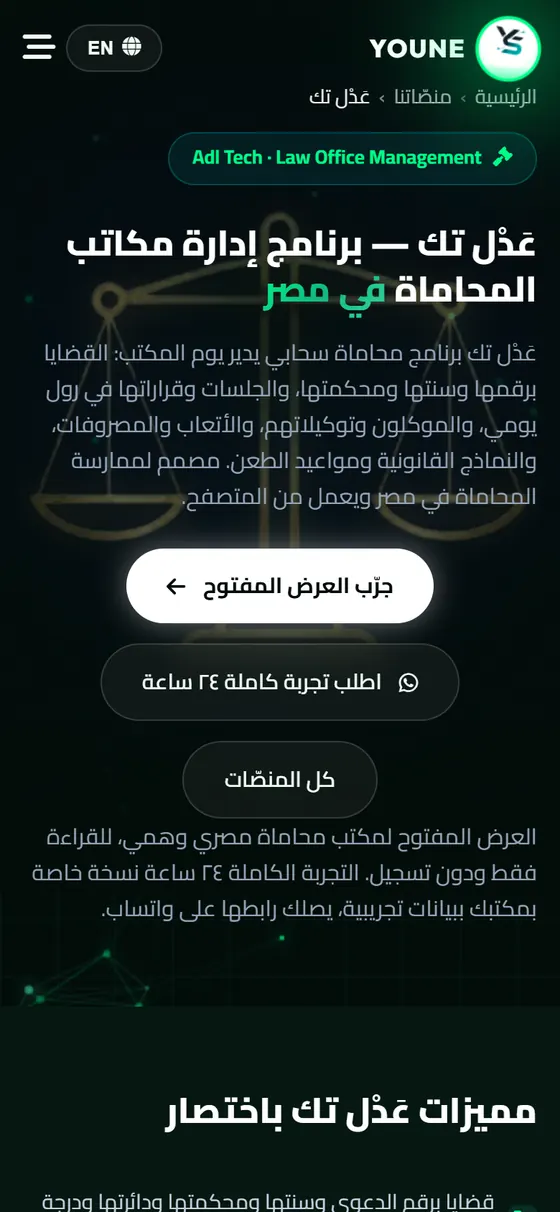
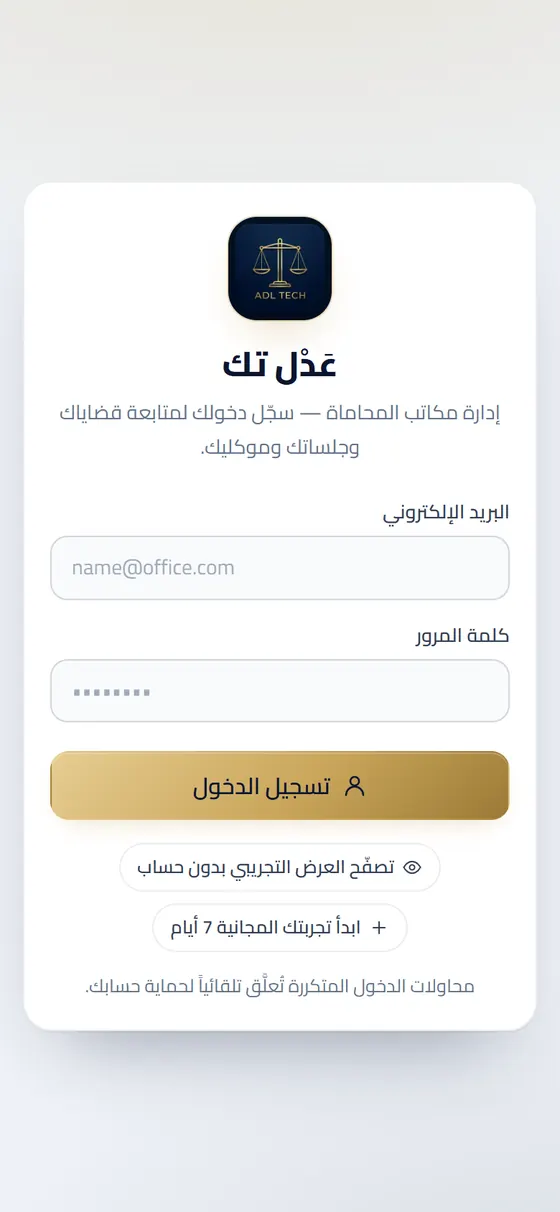
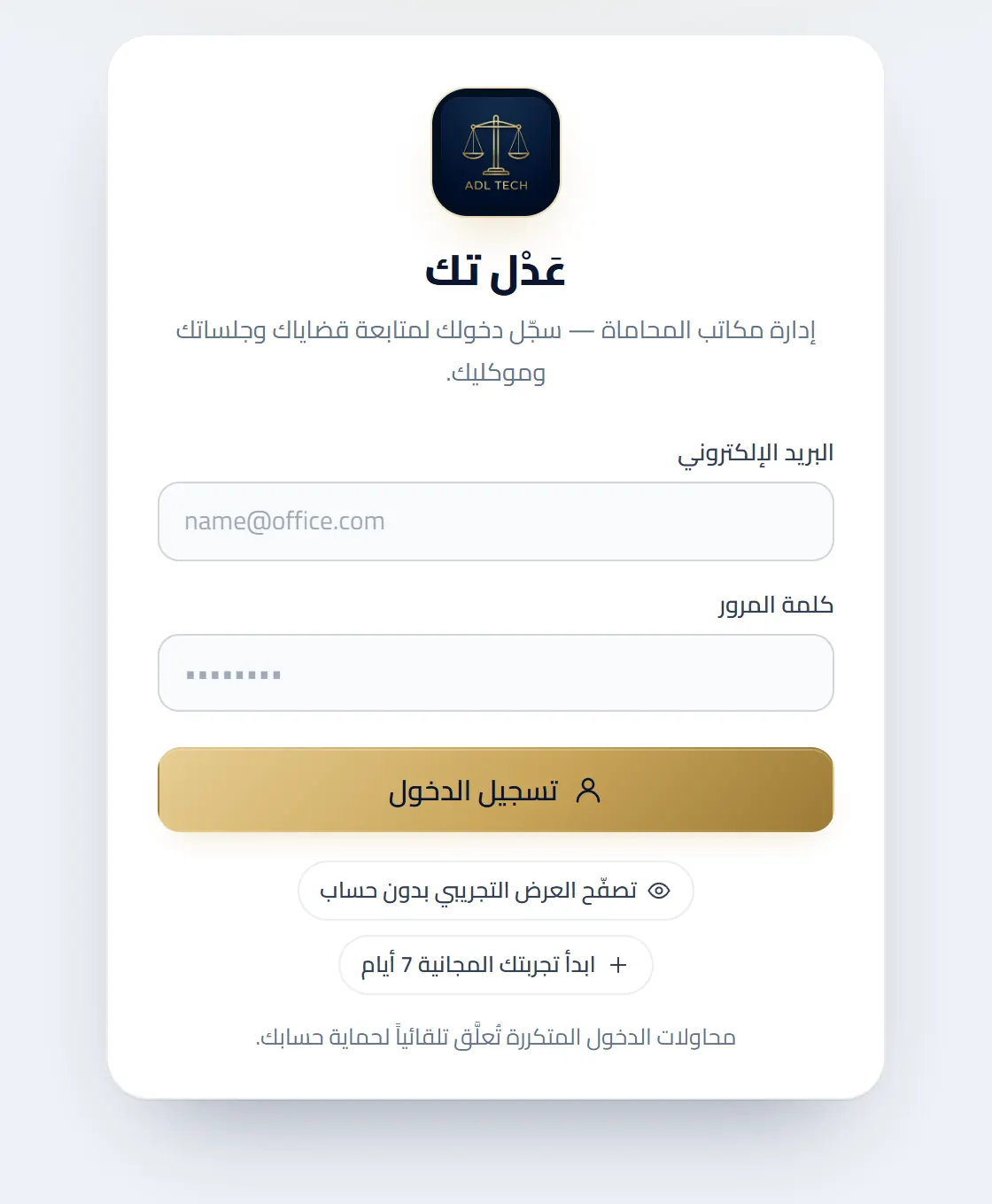

Younex developed the Adl Tech system for managing law firms, a complete SaaS system built on PHP and MySQL that runs the legal office's entire workflow: cases, clients, documents, appointments and hearings, with a central dashboard and a precise permissions system separating the roles of lawyers and staff, and secure electronic archiving of documents. The challenge was building a system that could absorb the sensitivity of legal data and the complexity of the workflow in law firms, with an easy Arabic interface a lawyer adopts without lengthy training. The result is a platform turning paper chaos into a disciplined digital system documenting every action and reminding of every appointment.
Project overview
Law firms are run on the finest details: a missed hearing can lose a case, a lost document can bring down a defence, and mixing up two clients' files can squander trust built over years. Despite this sensitivity, many firms in the Arab region are still run with primitive tools — scattered spreadsheets, paper files, and personal calendars that do not integrate. The Adl Tech project came to address this gap through a specialised digital system running the law firm from a single point, designed and delivered by Younex as a complete SaaS system serving firms of all sizes, from the sole practitioner to the multi-branch, multi-lawyer office.
The system rests on a simple central idea: everything concerning the legal office should live in one connected place. Instead of the client's data being in one place, their cases in another, their documents in a paper file and their hearing dates in a separate calendar, Adl Tech brings these elements together into a unified system; from the client file you reach their cases, and from the case you reach its documents, its hearings, its appointments and the actions taken on it. This interconnection is what turns the system from a mere "digital archive" into a genuine management tool giving the office manager a complete view of the workflow, and giving each lawyer a panel organising their daily tasks and appointments.
The real value of this kind of system does not appear on its first day but accumulates over time. With every case entered, every document archived and every hearing recorded, the system gradually becomes an institutional memory for the office that does not depend on any one person's recollection. When an employee leaves or a new lawyer joins, the knowledge stays preserved, organised and retrievable, which gives the office stability and an ability to grow without its workflow being hostage to particular individuals. This shift from dependence on people to dependence on the system is the essence of what Adl Tech offers; it does not merely digitise the paperwork but establishes an institutional working method that protects the office from human error, chaos and forgetfulness, and places it on the path of sustainable professionalism.
The client and the sector
The client is Adl Tech, a technology venture specialising in digital solutions for the legal services sector, targeting law firms and legal advisers in the Saudi, Gulf and wider Arab markets. The legal sector is conservative by nature, precise in its requirements, and extremely sensitive about data confidentiality, since the information the office handles — contracts, pleadings, client data and case documents — is highly private information whose leak or loss carries serious legal and professional liability. So any system serving this sector has to balance three sides: ease of use that encourages adoption, strength of function covering the complexity of legal work, and strict security protecting the sensitive data.
This market is also characterised by a wide variation in technical maturity between firms; some are looking for a system to replace the paper chaos entirely, and some want to organise a team of several lawyers and staff with different permissions. Younex's understanding of this variety pushed it to build a flexible system that scales with the size of the office, with an Arabic-first interface respecting the reading direction and reducing the learning curve, so that the lawyer — whose core work is law, not technology — can adopt the system and start working on it with the least possible training.
Nor can the rising regulatory dimension in this sector be ignored; the judicial systems in Saudi Arabia and the Gulf are moving towards more digitisation and electronic integration, and impose on firms a higher level of documentation, adherence to deadlines and record-keeping. This shift makes specialised digital systems an operational necessity rather than an optional luxury, since the office still relying on paper finds itself in a weaker competitive position and more exposed to errors and delay. Adl Tech is designed to place the office on the right side of this shift, by giving it a disciplined digital structure documenting every action, preserving every document and reminding of every appointment, so the office rises to the level of professionalism the modern client expects and the developing regulatory framework requires.
The challenge
The fundamental challenge was turning the complete workflow of a law firm — with all its complexity and branching — into a logical and easy-to-use digital system, without a simplification so severe it loses its usefulness, and without a complexity that repels the user. Legal office work is not linear; a single case may be linked to several clients, several hearings, countless documents and successive actions, and all of that has to stay organised, connected and instantly retrievable. The specific challenges included:
- Designing a database schema reflecting the complex relationships between clients, cases, documents and hearings without duplication or conflict.
- Building a precise permissions system separating the roles of the office manager, the lawyers, the staff and the assistants, so that each user sees only what concerns them.
- Guaranteeing strict security for sensitive legal data protecting it from unauthorised access, leakage and loss.
- Building an electronic document archiving system allowing upload, classification, search and fast retrieval.
- Developing an appointments and hearings system with alerts preventing any critical court date from being missed.
- Designing a central dashboard giving a complete view of the office's performance and the state of the cases.
- Building an easy Arabic interface reducing the learning curve and encouraging rapid adoption.
- Ensuring the system's scalability to serve offices of different sizes as a SaaS system.
The solution Younex delivered
Younex built Adl Tech on a PHP core in the back end with a MySQL database designed carefully to reflect the logical relationships in a legal office's work. We began from designing the database schema as a solid foundation linking clients to cases, and cases to documents, hearings, appointments and actions, with indexing guaranteeing query speed even as the volume of data grows. On top of this foundation we built the application logic, the dashboard and the permissions system, producing a complete SaaS platform managed through the browser without installation.
The solution focused on addressing each challenge with a dedicated function:
- A case management system documenting each case with its status, its stages, the actions taken on it and its complete history.
- A central client register linking each client to their cases, their documents and their contact details.
- An electronic document archiving system allowing documents to be uploaded, classified, linked to cases and searched.
- A role-based access control system governing what each user sees and does.
- An appointments and hearings calendar with an alerts system reducing the risk of missing court dates.
- A central dashboard presenting the office's performance indicators and the state of the cases at a glance.
- A multi-layered security layer covering password encryption, session protection, security headers and form protection.
- A scalable multi-user structure serving offices of different sizes.
Choosing PHP and MySQL as the system's foundation was a considered decision suited to the nature of an application managed through the browser and dealing with interconnected relational data. A MySQL database provides robustness and reliability in preserving complex relationships between entities, with high query performance when correctly indexed, which guarantees retrieval speed even as thousands of cases and documents accumulate. And building the application logic in custom PHP gave us precise control over the security and permissions layer, the most sensitive layer in any system handling confidential legal data. We deliberately avoided ready-made systems, because the particular nature of legal workflow and the strict security requirements need a bespoke solution rather than a generic template that forces the office to adapt its work to it. This custom approach is what makes Adl Tech a system that serves the lawyer in their own way rather than the reverse, and leaves the door open to future expansion and development without structural constraints.
Technical specification
| Item | Detail |
|---|---|
| Project type | A SaaS system for managing law firms |
| Backend language | Custom PHP |
| Database | MySQL with an indexed relational schema |
| Frontend | HTML5 + CSS3 + JavaScript (Vanilla) |
| Core modules | Cases, clients, documents, appointments and hearings |
| Permissions system | Role-based permissions (manager / lawyer / staff) |
| Document management | Upload + classification + linking to cases + search + archiving |
| Dashboard | A central panel with performance indicators and case status |
| Alerts system | Reminders for appointments and court hearings |
| Language and direction | Fully Arabic, RTL direction |
| Responsiveness | Works through the browser on mobile, tablet and desktop |
| Security | Password encryption + session protection + CSRF + security headers |
| Architecture | Multi-user and scalable (SaaS) |
The features delivered
- A comprehensive case management system documenting each case with its stages, its actions and its complete history.
- A central client register linking each client to their cases and documents in one place.
- Electronic archiving of documents with classification, search and fast, secure retrieval.
- A precise permissions system separating the roles of the manager, the lawyers and the staff and protecting data privacy.
- An appointments and hearings calendar with alerts preventing critical court dates from being missed.
- A central dashboard giving a complete view of the office's performance and the state of the cases at a glance.
- An easy Arabic interface reducing the learning curve and accelerating adoption of the system.
- A strict security structure protecting sensitive legal data around the clock.
How the project ran
- Workflow analysis: a detailed study of how law firms manage their cases, clients, documents and appointments in order to define the requirements precisely.
- Database design: building a relational schema reflecting the relationships between clients, cases, documents and hearings with appropriate indexing.
- Permissions engineering: designing the roles and permissions system defining what each user sees and does.
- Developing the core modules: programming the cases, clients, documents and appointments modules in PHP on top of the MySQL database.
- Building the dashboard: developing the central panel, the performance indicators and the administrative interfaces.
- The archiving and alerts system: developing document upload, classification and search, and the appointment alerts system.
- Strengthening security: applying the protection layers of encryption, session and form protection and security headers.
- Testing and launch: comprehensive functional and security testing, then publication as a SaaS system with follow-up and support.
User experience and design
We recognised from the start that Adl Tech's audience are lawyers and legal assistants, not technical experts, and that the success of any management system is measured by how far its users adopt it, not by the number of its features. So we designed the interface on the principle of clarity above all: a logical organisation reflecting the way a lawyer thinks about their work, so they move from the client file to their cases, and from the case to its documents and hearings, along intuitive paths needing no user manual. We adopted a fully Arabic RTL interface, with clear typefaces, large buttons and understandable labels, to reduce friction and speed up daily work.
The dashboard was designed to be the lawyer's starting point every morning: one glance reveals the upcoming appointments, the cases needing follow-up and the pending tasks. As for the permissions system, it was designed to work quietly in the background; it does not burden the user with complexity but shows each person only what concerns them, so the employee sees their tasks and the manager sees the full picture. This balance between apparent simplicity and underlying power is the essence of the user experience we built, so that the lawyer feels the system serves them rather than being an additional burden on their day.
We also focused on reducing the number of steps needed to complete recurring tasks, because any small daily friction accumulates over time into a reason to abandon the system. Adding a new case, linking a document to it, recording a hearing, searching for a client file — all of these were designed to be done in the fewest clicks along clear paths needing no thought. We adopted structured input forms preventing common errors, clear confirmation messages on sensitive operations, and a fast search bringing the user to what they want immediately however large the data volume. The result is a system with which the lawyer feels their time is being saved rather than consumed, and that is the real criterion determining whether a system becomes part of the office's daily routine or merely a tool neglected a short while after adoption.
Results and impact
Adl Tech turned the management of a legal office from a scattered paper process into a disciplined digital system documenting every action and linking every element to its context. The office can now retrieve any document or case detail in seconds instead of searching through paper files, the risk of missing court dates has fallen thanks to the alerts system, and the level of discipline in following cases has risen through the central documentation of every stage and action. The permissions system gave the office manager clearer control over their team and stronger protection for the privacy of client data, while the dashboard provided a complete managerial view supporting decision-making. And as a scalable SaaS system, the project opened for Adl Tech the opportunity to serve multiple offices on the same structure, which makes it the foundation of a technology product able to grow in a market where demand for legal digitisation is rising.
The system's impact extends beyond operational efficiency to touch the quality of the service delivered to the client themselves. When a lawyer can reach the complete history of their client's case, its documents and its actions immediately, they give more precise and faster advice, answer their client's enquiries with confidence, and present the image of an organised office worthy of trust. This professional impression reflects directly on the office's reputation and its ability to retain its clients and attract others. And from Adl Tech's angle as a technology venture, the system proved the viability of a model offering a specialised solution for a precise and growing sector, and laid an infrastructure open to future development with additional features such as integration with the electronic judicial systems, invoice and fee management, and advanced analytical reports, so that it moves from being a management system to a complete legal working framework growing with the market's needs.
Frequently asked questions
What core modules does the Adl Tech system manage?
The system manages four connected modules: cases with their stages and actions, the client register, the electronic document archive, and appointments and hearings with alerts. All of them are linked within one structure allowing a smooth move from the client to their cases to their documents and hearings.
How does the system protect the confidentiality of sensitive legal data?
Through multiple security layers covering password encryption, session protection, protecting the forms from CSRF attacks, and security headers at the server level, in addition to a permissions system restricting each user's access to what concerns them only, so client and case data stays protected from unauthorised access.
How does the permissions system work?
The system relies on role-based permissions; each role (office manager, lawyer, employee, assistant) has a defined scope within which they see what concerns them and perform only the tasks permitted to them. This protects data privacy and organises the team's responsibilities within the office.
Does the system suit small and large offices equally?
Yes. Adl Tech was built with a scalable multi-user structure serving the sole practitioner as it serves the office with several lawyers and branches, and the system can grow with the size of the office without needing to be rebuilt.
How does the system prevent appointments and hearings being missed?
Through a central appointments and hearings calendar linked to the cases, equipped with an alerts system reminding lawyers of upcoming dates, which considerably reduces the risk of missing any court hearing or critical appointment.
Do lawyers need lengthy training to use the system?
We designed the Arabic interface on the principle of clarity and simplicity to reflect the way a lawyer thinks about their work, so the learning curve is short and the user can start working with the least possible training. The intuitive dashboard makes the daily tasks direct and fast.
What technologies was the system built with?
Adl Tech was built on a custom PHP core and an indexed relational MySQL database, with a front end in native HTML, CSS and JavaScript. This custom foundation gives full control over security, performance and scalability away from the constraints of ready-made systems.