

Younex built the Royal Holiday Veloria website at royalholidayveloria.com: the site of a local travel team in Sharm El Sheikh that arranges hotels, airport pick-ups and sea and desert excursions for travellers from Germany, France, Saudi Arabia and the UAE. The site runs in four languages: English on the home page, and Arabic, German and Russian each on its own path. It has a page for every departure country, 19 hotel pages grouped by the areas of Sharm, 11 excursion and activity pages, a travel guide, an enquiry form that lands in an admin dashboard, and a WhatsApp button on every page. The site is built with Next.js, and all of its content is edited from an admin dashboard made specifically for it.
Overview
A travel company in Sharm does not sell plane tickets from its website. Someone thinking of flying from Frankfurt or Riyadh has questions before booking anything: how long is the flight from my country? Do I need a visa? Which part of Sharm works for a family with children, and which works for a couple who want quiet? Who will meet me at the airport? Can I book the Ras Mohammed trip without booking the hotel with you? These questions get asked in four languages, and every customer wants to talk to someone in their own.
So the site was built around one clear goal: travellers find the answers to their questions in their own language, then send their request in one clear message, on WhatsApp or through a form, and the team replies with a detailed offer for their dates. There is no online booking or payment, and that is deliberate. In this kind of travel the deal is closed in the conversation, and the site's job is to bring the customer into that conversation already knowing what they want.
The site has seven main pages: the home page, holidays by departure country, hotels, excursions and activities, the travel guide, about, and contact. Under them sit 4 country pages, 19 hotel pages, 11 excursion pages, 3 articles, and two pages for the imprint and the privacy policy. Each of these pages exists in all four languages, so the sitemap holds 176 links.
About the client and the sector
Royal Holiday Veloria is a travel team that lives and works in Sharm El Sheikh, in South Sinai. Its work is putting a whole Red Sea holiday into one plan: the hotel, the private transfer from Sharm El Sheikh International Airport to the hotel and back, and excursions with pick-up from the hotel door. Its customers are defined from the start: travellers from Germany, France, Saudi Arabia and the UAE. The team speaks English, German, Arabic and Russian, and has a WhatsApp line in Egypt and a German phone line for customers in Germany.
The company was previously called "Egypt Royal Holidays", on the domain royalholidays-eg.com. In November 2026 the brand changed to Royal Holiday Veloria on a new domain, and the site moved with it, every page included.
The Sharm El Sheikh market is crowded. A German traveller compares large international booking sites, a Saudi traveller usually asks on WhatsApp, and a Russian traveller searches in Russian. The hotels have their own websites too. A local company with no pages in the customer's language leaves all of that space to the booking sites, even when it is the one that knows the place best.
The challenge
The first problem was the number of languages. Four languages are not two: each has a different audience, Arabic is written right to left, and Russian uses a different alphabet altogether. Machine translation on top of an English site would not convince anyone, and separate copies for each language, each edited on its own, would within a month have a missing hotel in German or an old number in Russian.
The second problem: the content is large and branches out. 19 hotels in different areas, each area with its own character, 11 excursions across sea, desert and town, and 4 departure countries, each with its own flight time, entry rules and seasons. That needs an order that gets visitors to what matters to them without getting lost, and lets Google understand every page on its own, in its own language.
The third problem was that the team itself had to be able to make changes. A new hotel gets added, an excursion is dropped for a season, a WhatsApp number changes, a new question keeps coming up from customers. If every one of those changes needed a developer, the site would stay stuck on its first version.
The fourth problem: the change of name and domain came in the middle of the work. The old domain had links and social media shares pointing to it, and moving the site without proper redirects would mean every old link landing on an error page, with Google starting from zero.
And the fifth problem was in the requests themselves. The company needs to know from the first message where the customer is travelling from, whether they want a hotel, excursions or both, when, and how many people. Without that, the first conversation turns into ten messages of questions before anyone can start working.
The solution
We built the site on Next.js 15 and React 19, and every page is rendered on the server in its own language, so Google finds the text ready in the page without waiting for any script. The languages have fixed paths: English at /, Arabic at /ar, German at /de and Russian at /ru. Every content field on the site, from a hotel's name to the answer of a frequently asked question, is stored with four values, one per language. So a hotel is a single entry in the admin dashboard, and all four versions come out of it with the same design and the same photos.
The Arabic pages open right to left in the Cairo typeface, while English, German and Russian use Montserrat in its Latin and Cyrillic character sets. When a visitor opens the site for the first time without choosing a language, the site reads their browser language, sends them to the matching version and remembers the choice. Search crawlers, on the other hand, see the page they asked for without any redirect, so each language is indexed on its own URL. And since there is no French version, a visitor with a French browser goes to English.
The content is ordered the way a traveller thinks. The first question is "where am I flying from?", so there is a page for each country. Next comes "where will I stay?", so the hotels are grouped by the areas of Sharm: Nabq Bay, Naama Bay, Sharks Bay, Ras Nasrani, Montazah, Hadaba, Um El Sid Plateau and Soho Square. Then "what will I do there?", so the excursions fall into three categories: sea and reefs, desert safari, and city and culture. Every page links to the others: a country page suggests hotels and excursions, and a hotel page shows other hotels in the same area and excursions that go well with the stay.
The content starts out as JSON files in the code, and when the site first runs it is moved into a MySQL database; from then on every edit in the admin dashboard is saved there and appears on the site straight away.
Requests have two routes. On the home page there is a small planner bar: the visitor picks where they are flying from, what they want, which month and how many people, and taps "Get my offer", which opens WhatsApp with a message that already lists all of their choices. On the contact page there is a longer form that is saved in the admin dashboard, and after sending it offers the visitor a button to send the same summary on WhatsApp if they want to continue there.
The domain change was handled with a 301 redirect from every link on the old domain to exactly the same page on the new domain, not to the home page. So someone who clicks an old link to a particular hotel reaches that same hotel's page.
Technical specifications
| Item | Details |
|---|---|
| Project type | A four-language travel company website in Sharm El Sheikh, with hotel, excursion, departure-country and travel-guide pages and a full admin dashboard |
| Build | Next.js 15, React 19 and TypeScript, with every page rendered on the server in its own language |
| Content | A MySQL database, with the initial content moved in from JSON files on first run |
| Pages | Home, 4 departure-country pages, 19 hotel pages in 9 areas, 11 excursion pages in 3 categories, 3 articles, about, contact, imprint and privacy, and a 404 page in every language |
| Languages | English, Arabic, German and Russian, with hreflang tags for all four and x-default, and a sitemap of 176 links with the alternate-language links for every page |
| Structured data | TravelAgency, Organization and WebSite on every page, Hotel for hotel pages, TouristTrip for countries and excursions, BlogPosting for articles, FAQPage, BreadcrumbList, CollectionPage and ItemList for the hub pages, and AboutPage and ContactPage |
| Requests | A ready-made WhatsApp message from the planner bar, and an enquiry form that is saved in the admin dashboard and continues on WhatsApp |
| Admin dashboard | Hotels, excursions, countries and articles in all four languages, FAQs for every page, SEO titles and descriptions, a media library, an enquiries inbox with statuses and CSV export, and contact settings |
| Answer engines | An llms.txt file summarising the company, its pages and its languages, and a robots.txt that names and allows the crawlers of ChatGPT, Claude, Perplexity, Google-Extended, Applebot-Extended and others |
| Security | Content-Security-Policy with a nonce per request, HSTS, X-Frame-Options, Permissions-Policy, spam protection on the form, and passwords hashed with scrypt |
| Images | Every uploaded image is converted to WebP and resized automatically with the sharp library |
| Motion | GSAP for animation and Lenis for smooth scrolling, loaded after the page has finished, and switched off for visitors who have reduced motion turned on |
Key features
A home page that opens with a question: where are you flying from?
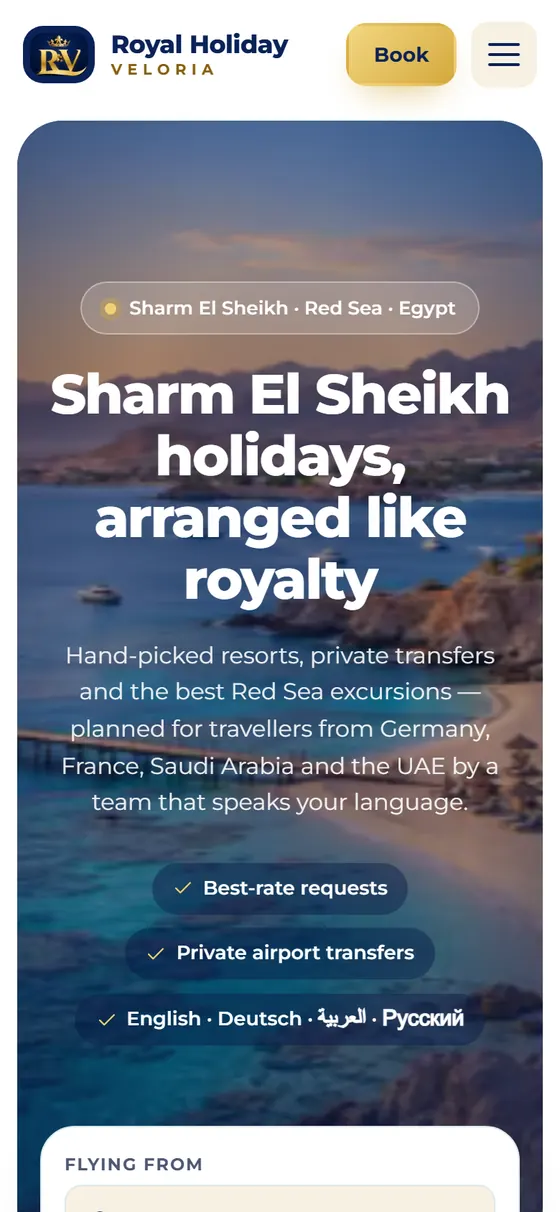
The first screen has the main heading about Sharm El Sheikh holidays, and under it a planner bar with four choices: flying from Germany, France, Saudi Arabia or the UAE; looking for a hotel and excursions, a hotel only, excursions only or a diving holiday; the month, from a list of the coming months or "flexible"; and the number of guests. One button turns those choices into a WhatsApp message written in the visitor's language. Below the bar a moving line runs the names of places: Ras Mohammed, Tiran Island, White Island, Naama Bay and the Sinai desert.
Country cards shaped like a boarding pass
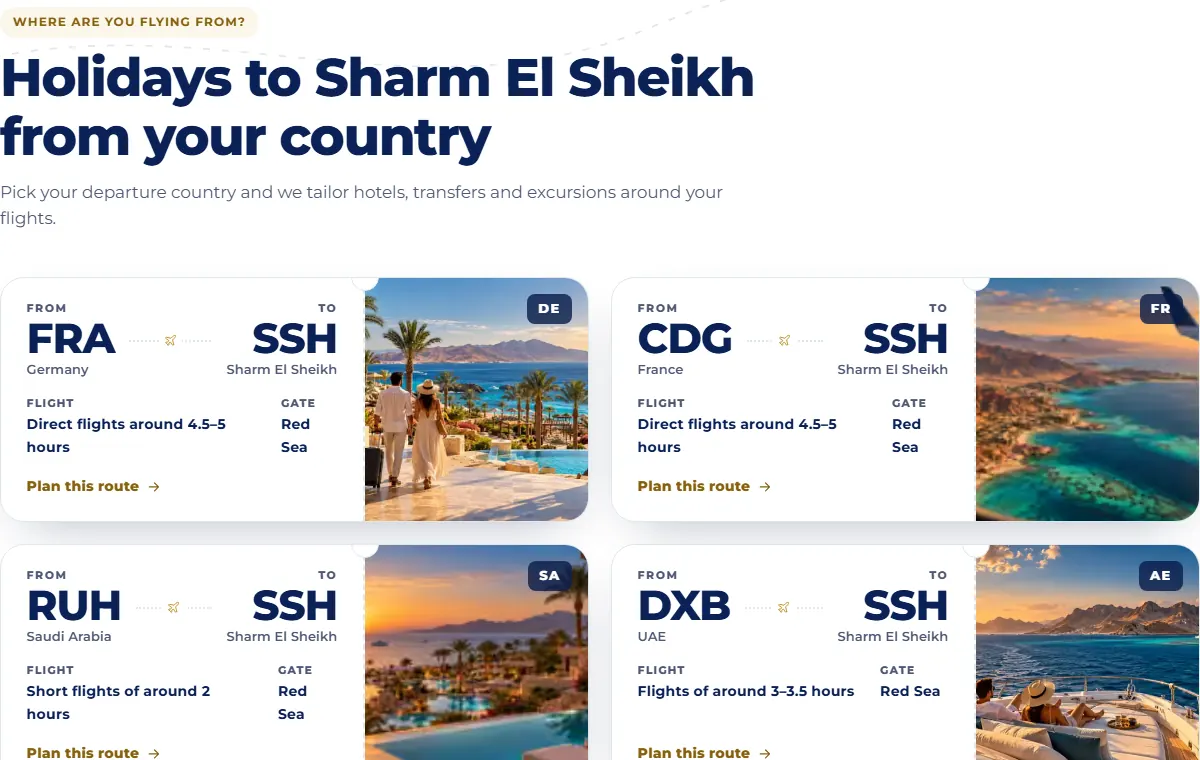
Each departure country has a card that looks like a boarding pass: from FRA to SSH, the approximate flight time, and the gate, "Red Sea". As you scroll through this section a small plane travels along a curved line behind the cards and draws its trail as it goes. The card itself tells the visitor the first thing they are looking for: how long the flight from their country takes.
A page for every departure country
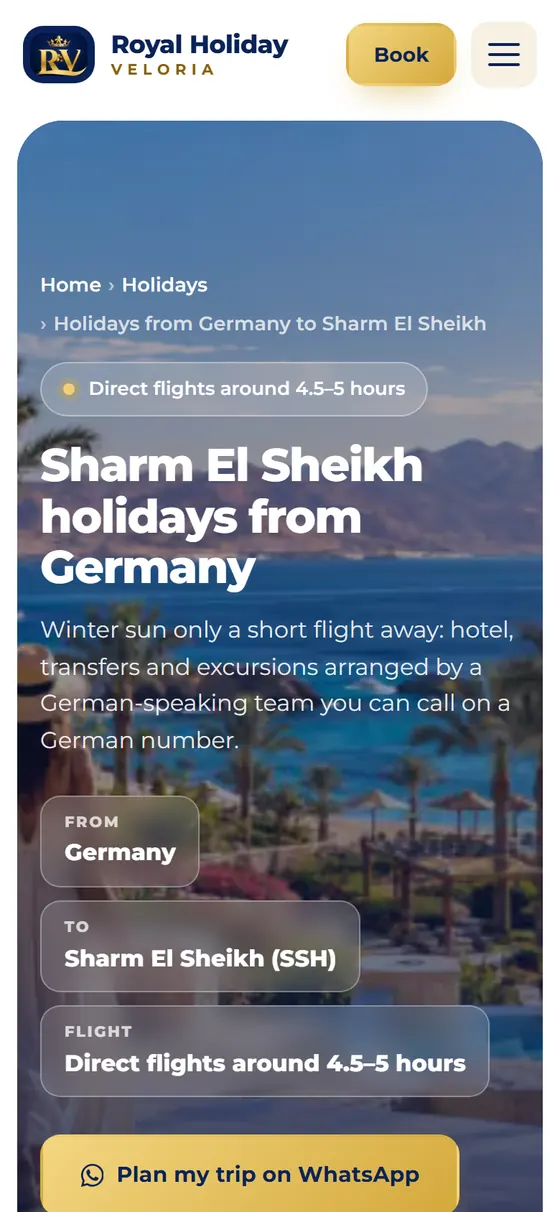
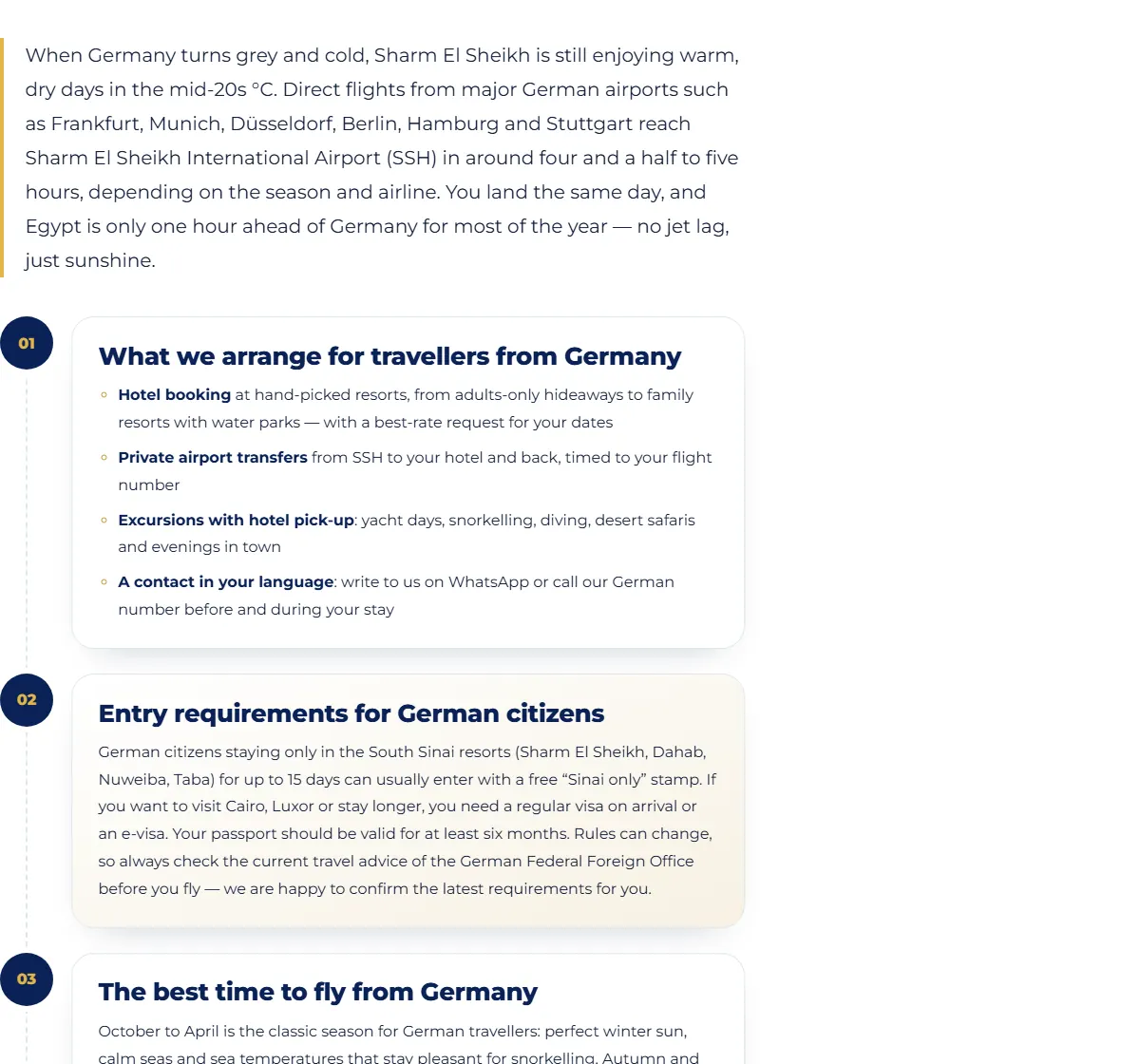
The Germany page, for example, opens with the direct flight time from the main German airports and the time difference, then what the team arranges for German travellers, the entry rules for German citizens with advice to check the official travel guidance before flying, the best time to travel from Germany, which part of Sharm suits whom, and the excursions customers add to their week. Every country page has its own FAQs and suggested hotels. France, Saudi Arabia and the UAE follow the same layout, each with its own information.
Hotels by area
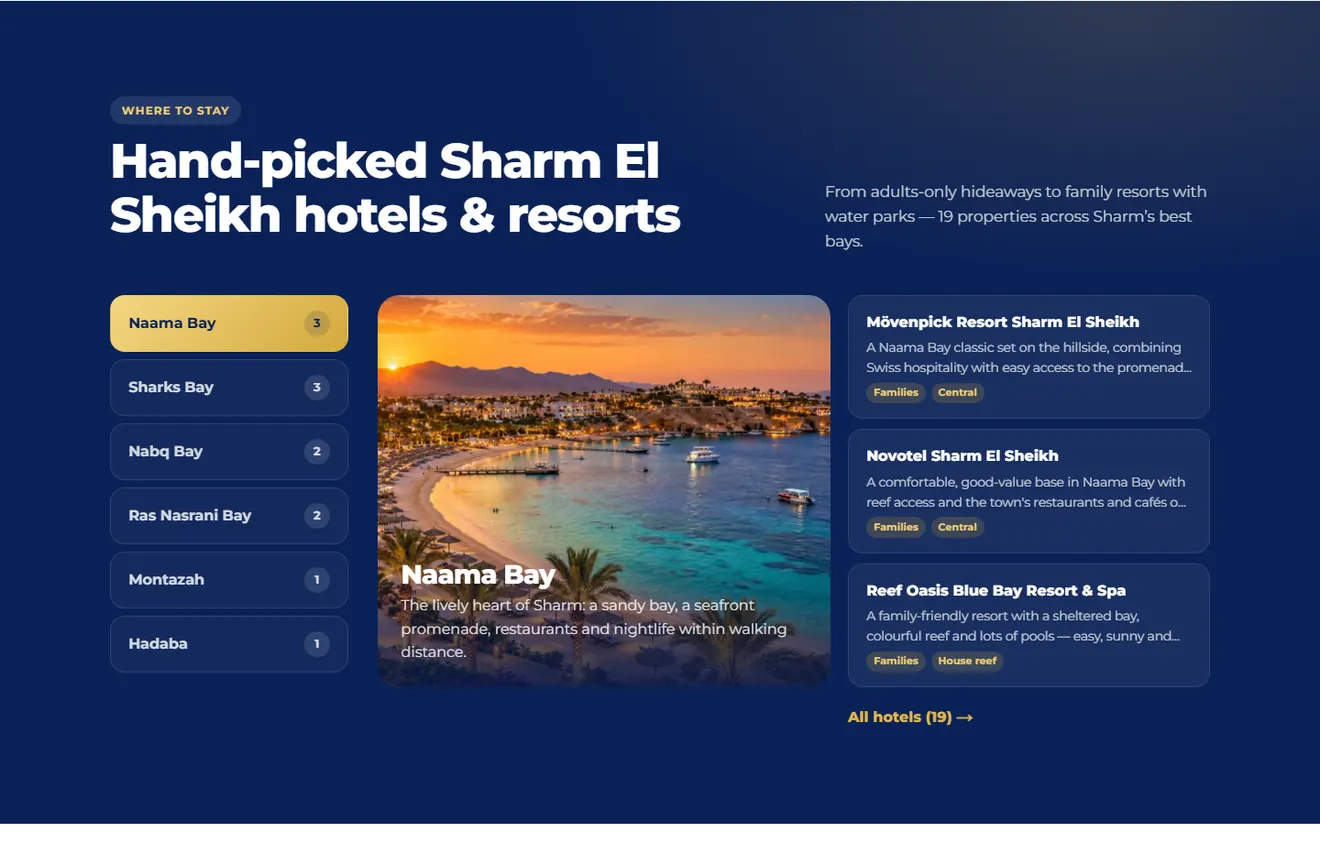
The hotels page is divided by the areas of Sharm, and next to each area is its number of hotels and a short description of its character: Naama for those who want to walk to restaurants and nightlife, Nabq for families who want space, Sharks Bay and Ras Nasrani for those who love snorkelling on the reef. The hotels include names such as Rixos, Four Seasons, Baron, Mövenpick and Novotel, and each hotel has a page with its description, highlights and tags: families, adults only, all inclusive, house reef. If a hotel has no photo of its own, the page shows a photo of the area with a note underneath saying the photo shows the area, not the hotel itself. And the star-rating field in the admin dashboard is left empty when the team is not sure of the official rating, instead of the site printing a number it cannot stand behind.
A page for every excursion
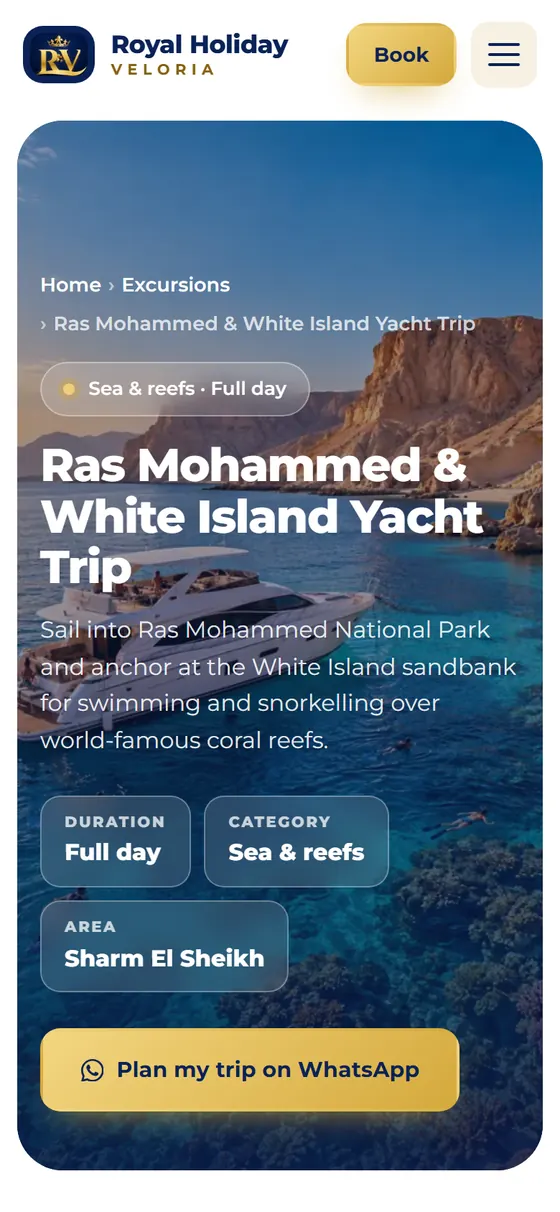
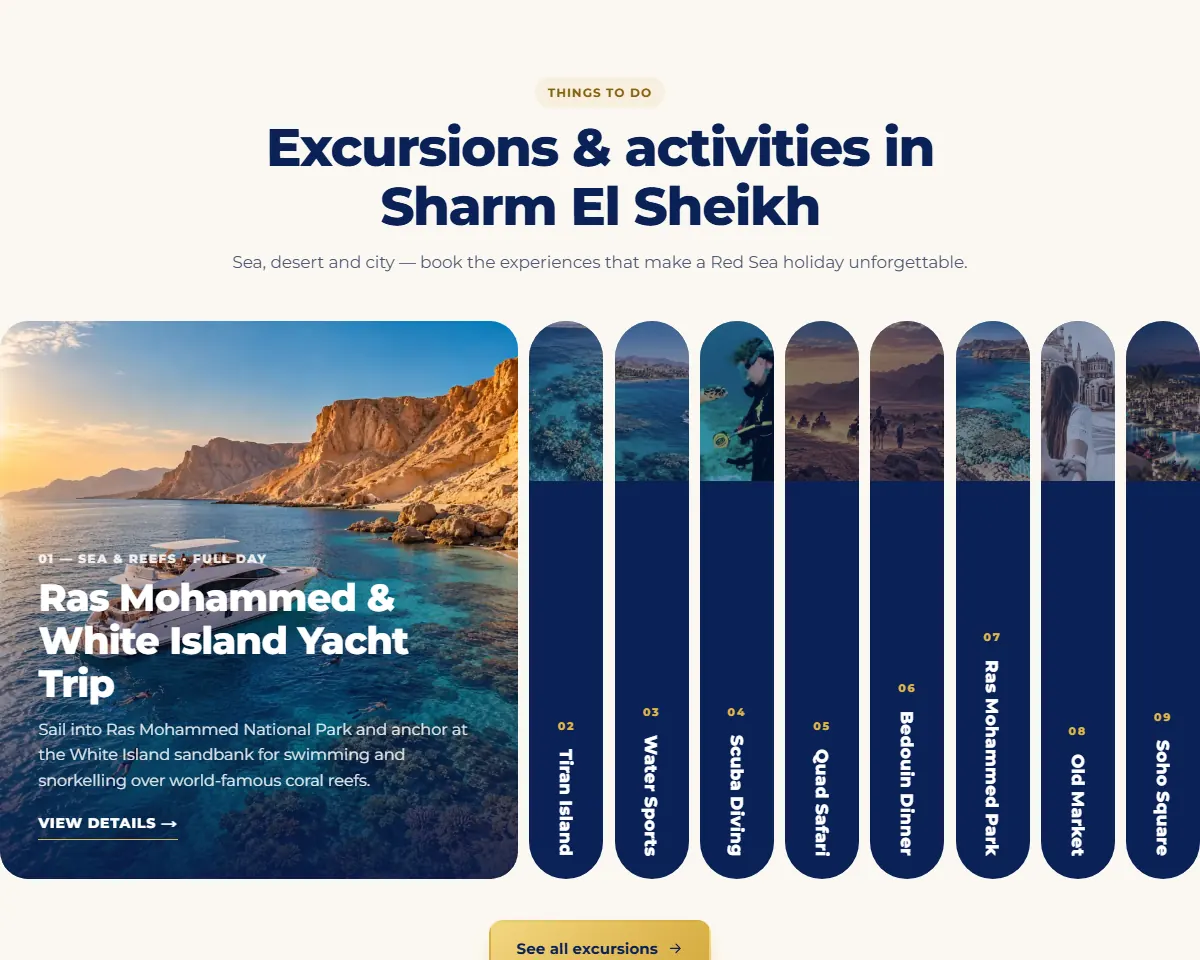
Each of the 11 excursions has a page: the Ras Mohammed and White Island yacht trip, Tiran Island, water sports, scuba diving with licensed dive centres, quad bikes and buggies in the desert, the camel ride and Bedouin dinner, Ras Mohammed by land, the Old Market and Al Sahaba Mosque, an evening at Soho Square, Hollywood Sharm, and the Sharm El Sheikh Museum. The page has the duration and category of the trip, a description of the day, what is included, its own FAQs, and a note that pick-up is from the hotel. Visitors can book an excursion even if their hotel is booked elsewhere.
An enquiry form that continues on WhatsApp
The contact form asks the questions the team used to ask in the first conversation: name, email or WhatsApp number, departure country, interest, arrival and departure dates, number of adults and children, and a message. A name and at least one of email or phone are required, along with consent to the details being used to answer the request. After sending, the request is saved, and the visitor sees a confirmation with a button that sends a summary of their request on WhatsApp. The form works even when JavaScript is switched off in the browser.
A travel guide with a table of contents and an update date
The travel guide has 3 articles so far: the best time to visit Sharm El Sheikh month by month, a guide to Ras Mohammed National Park, and a packing list. Each article has a table of contents at the top, the author's name, the publish date and the last-updated date, the reading time, share buttons, and in-text links to the related excursion pages.
An admin dashboard in four languages
The admin dashboard manages hotels, excursions, departure countries and articles. Every text field has four inputs, one per language, along with the SEO title, the description and the main heading for every page. There is a section for each page's FAQs, which appear on the page and in the FAQPage data at the same time, an SEO section for the seven main pages, a section for static pages such as about and the imprint, and settings for the phone numbers, address, opening hours, social accounts and the figures shown on the home page. The media library asks for an image description before upload and names the file from that description.
An enquiries inbox
Requests from the form land in an inbox inside the admin dashboard. The dashboard's home screen shows the number of new requests and of requests this week, and each request has a status: new, contacted, booked, closed. The team can filter by status and export the requests as a CSV file that opens in Excel with Arabic displayed correctly.
Implementation stages
- Defining the audience: with the client we set the four markets and the four languages, and the questions customers actually ask before booking.
- Page map: we split the content into departure countries, areas, hotels, excursions and the guide, with each page having one topic and one search intent.
- Design: an identity in Red Sea colours, country cards shaped like a boarding pass, and GSAP motion loaded after the page so it does not weigh it down.
- Languages: we built the four paths, right-to-left Arabic with its own typeface, and the redirect of a first-time visitor to their browser language with their choice remembered.
- Content: we wrote the country, hotel and excursion pages, the FAQs and the articles in all four languages.
- Admin dashboard: the four-language collections, FAQs, SEO, media, requests and settings, with a sign-in using a hashed password and a lock after failed attempts.
- Technical SEO: canonical and hreflang on every page, a sitemap with alternate-language links, structured data for every page type, and redirects that send links with a trailing slash or .php to their correct form.
- Answer engines: the llms.txt file, robots opened by name to AI crawlers, and the admin dashboard closed to indexing.
- Launch and domain move: publishing the site, and after the rebrand, a 301 redirect from the old domain to the same page on the new one.
User experience
A visitor arriving from Google on a phone sees a clear heading about Sharm holidays on the first screen, and right under it the bar that asks where they are flying from. At the top there is a language switch with all four languages, a "Book now" button, and a side menu with every page and a WhatsApp button. There are no pop-ups covering the page.
Visitors who know what they want get there without going round in circles: someone who has already booked a hotel goes straight to the excursions, someone unsure about the area finds the hotels grouped by area with a description next to each, and someone with a question about visas or the season finds it in the FAQs on the home page or on their country's page. Every hotel and excursion page has a "Plan this with us" box with a WhatsApp button and a quote request button.
The Arabic version is not a mirror of the English one. The headings are written in Arabic, the months in the planner bar use Arabic numerals, and the whole page runs right to left. A 404 page exists in every language, so anyone who types a wrong link lands on a page in their own language.
Results and impact
The site is live at royalholidayveloria.com in four languages, and each of the 176 links in the sitemap is tied to its versions in the other languages with hreflang. Every page type carries its own structured data: hotel, trip, article, FAQ and breadcrumb trail. And the old domain redirects every link to the same page on the new one.
We will not publish traffic figures, rankings or request counts here; that is the client's data. What we can say is that the company now has a site that speaks to its German customer in German, its Saudi customer in Arabic and its Russian customer in Russian, from one source. A new hotel is added once and appears in all four versions, and a new question is written once and appears on the page and in Google's data.
Requests now reach the team complete from the first message: the country, the interest, the dates and the number of people, whether they come on WhatsApp from the planner bar or from the form into the inbox. The team can follow every request by its status until it is booked or closed, and edit the whole site without going back to a developer.
Frequently asked questions
What is the Royal Holiday Veloria website?
The site of a travel team in Sharm El Sheikh, built by Younex at royalholidayveloria.com. It has pages for travel from Germany, France, Saudi Arabia and the UAE, 19 hotels grouped by the areas of Sharm, 11 excursions and activities, a travel guide, an enquiry form and WhatsApp buttons.
How many languages is the site in?
Four: English on the home page, Arabic at /ar, German at /de and Russian at /ru. Every page exists in all four and they are linked to each other with hreflang tags, and a new visitor is redirected to their browser language.
Does the site take bookings and payments online?
No. The site presents the hotels and excursions and collects the customer's request, and the team replies with a detailed offer for their dates. The request arrives either as a ready-made WhatsApp message or from the form into the inbox in the admin dashboard.
How does the team edit the content?
From an admin dashboard made for the site: hotels, excursions, departure countries, articles, FAQs, SEO, images and settings. Every text field in it comes in all four languages, and edits show up on the site straight away.
What happened to the old domain?
The old domain royalholidays-eg.com still works, and it 301-redirects every link to the same page on royalholidayveloria.com. So any old link that was shared reaches the right page on the new domain.
What is the point of an llms.txt file on a travel site?
It is a text file that summarises the company for tools such as ChatGPT and Perplexity: what it does, for whom, in which languages, and what its main pages are. When someone asks those tools about a travel company in Sharm that speaks their language, they have an official source to draw on.
How is the form protected from spam?
With more than one layer: a hidden field that catches bots, a token that confirms the form was sent from the site itself, and a limit on the number of requests from the same source in a short time. The IP address is not stored as it is; it is stored hashed.
Does the site work well on mobile?
Yes, the pages are designed mobile first, with a side menu and clear WhatsApp buttons. The motion only loads after the page, it stops for visitors who have reduced motion turned on, and the images are WebP.