
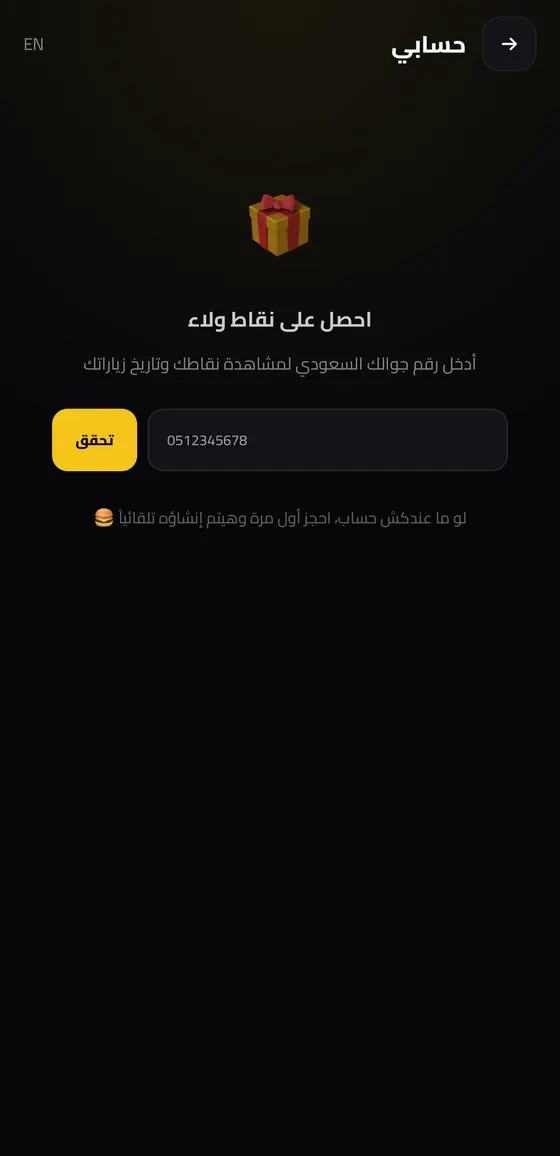
Younex built the First Street Burgers website at firststreetburgers.com: the site of a smash-burger restaurant in An Narjis, north Riyadh, with an English home page and a full Arabic version, a bilingual menu page with prices and calories, and two long Arabic guides, one on smash burgers and one on choosing a burger in Riyadh. The site is a set of light HTML pages with no database, it has a light and dark mode, structured data for Google on every page, and an llms.txt file for answer engines. We had already built the same restaurant its queue and loyalty app, and the website points to it.
Overview
This restaurant does not need a website to sell online. Orders happen at the counter, and the crowds are handled by the app. What was missing was a place that answers diners before they leave home: where is it, how late is it open, what does a burger cost, do I have to queue? Those answers were scattered across Instagram, Google Maps and the queue page, and there was no single page that pulled them together and showed up in search under the restaurant's name.
So the site was built around one clear goal: anyone who types the restaurant's name in any spelling, or types "smash burger Riyadh" or "best burger in Riyadh", should find a page from the restaurant itself that answers them in Arabic or in English. Everything on the site, from the order of the sections to the robots file, was built around that goal.
The site has five main pages: the English home page at /, the Arabic home page at /ar, the menu at /menu, the guide at /smash-burger-riyadh and the guide at /best-burger-riyadh. Alongside them sit an Arabic 404 page, a sitemap, a robots file and an llms.txt file.
About the client and the sector
First Street Burgers is a smash-burger restaurant at 8448 Anas Ibn Malik Road, An Narjis, north Riyadh. Its line is "From Cali to the Kingdom", meaning a California-style burger: a ball of fresh Angus beef pressed hard onto a hot griddle the moment it lands, so it comes out as a thin patty with crispy edges. The menu is short and focused: three burgers, three kinds of fries, ice cream, milkshakes and drinks, and six sauces.
The restaurant opens from 1 PM to 1 AM Saturday to Wednesday, stays open until 2 AM on Thursday and Friday, and opens at 1:15 PM on Friday. Its customers in Riyadh speak Arabic and English, Saudis and residents alike, which made both languages a requirement from day one rather than an extra.
The burger market in Riyadh is crowded. Anyone who searches Google for a burger runs into "top 10 restaurants" lists from review sites, delivery app pages and maps. A restaurant without a page that speaks for itself leaves the talking to everyone else.
The challenge
The first problem was the name itself. "First Street" is written two ways in Arabic, and some people drop the s from Burgers. The site had to make Google understand that all of these are the same restaurant.
The second problem was the two languages. An English site with a machine-translate button on top would not convince a Saudi diner, and an Arabic-only site would lose the residents. At the same time it made no sense to keep two separate versions edited one by one, because two months later the Arabic one would show an old price or be missing a section.
The third problem was content. A restaurant home page carries little text by nature, and that is right: diners want to see the food, not read about it. But a page with little text will not rank on its own for phrases like "smash burger Riyadh". We had to find a home for the long-form content without weighing down the home page.
The fourth problem is that a large share of questions now go to ChatGPT and Perplexity, not only to Google. If those tools cannot find a clear source about the restaurant, they answer from whatever they find, or confuse it with anything else called a smash burger.
The solution
We started with keyword research. The raw file holds 8,485 search terms about burgers, smash burgers and restaurants in Riyadh, which we filtered down to 504 target keywords: 5 brand terms, 113 local terms tied to Riyadh and its districts, and 386 category terms. Of those, 328 are Arabic and 176 English. That map decided how the pages were split: the home page for the brand, the location and the hours, the menu for prices, and two guides for the broad terms.
The English home page is the source. The Arabic version is built by a Python script called build-ar.py: it takes the English page, swaps the title, description, Open Graph data, canonical and visible copy, flips the direction to RTL, and leaves the design and scripts as they are. If we change the design of a section in English, we run the script and the Arabic page updates with it, with nobody copying anything by hand.
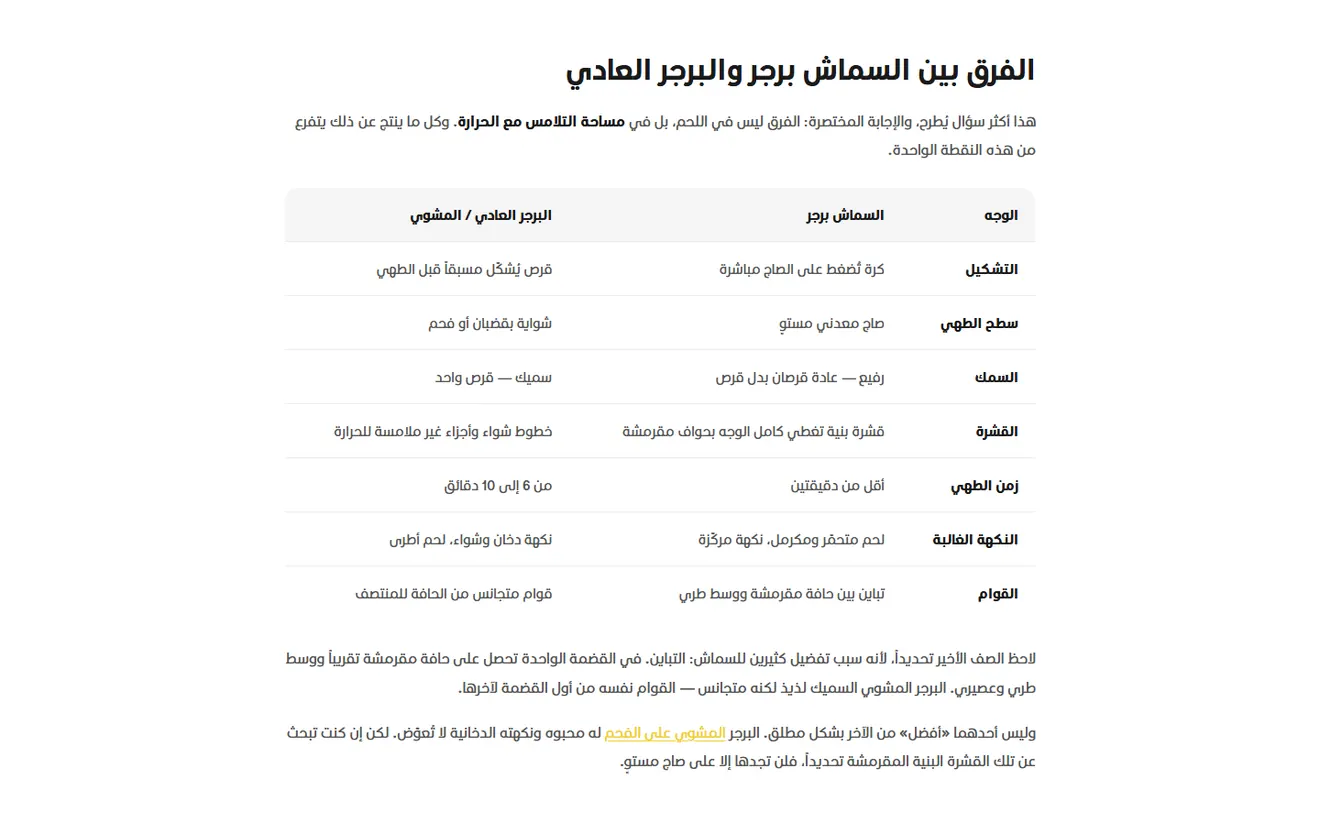
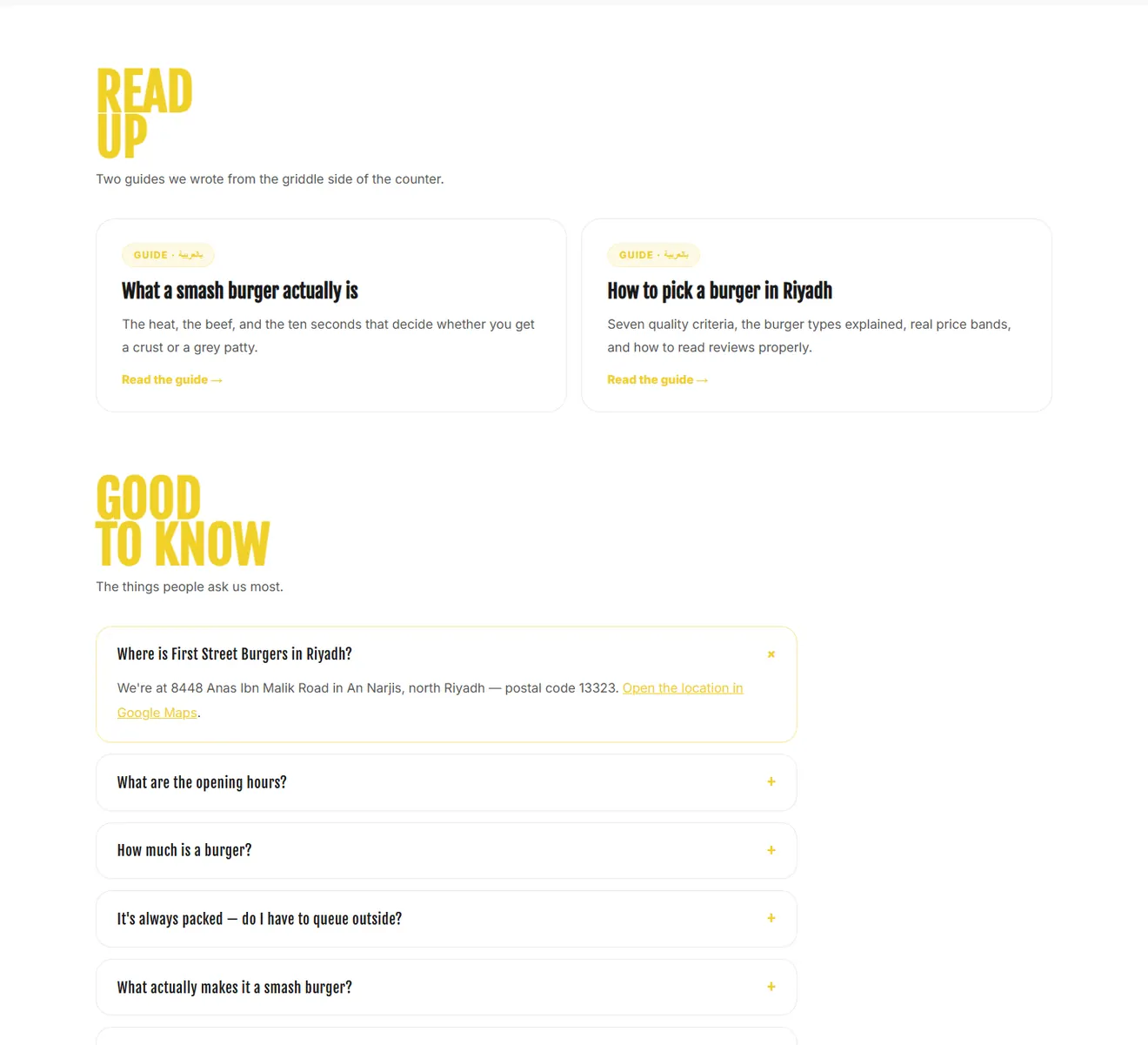
The long-form content went into the two guides. "Smash burger Riyadh" explains what a smash burger is, how it differs from a grilled burger in a comparison table, why pressing changes the taste, five mistakes that ruin a smash burger, and how to spot a good one before the first bite. "Best burger in Riyadh" opens with a blunt line: we are not going to give you a top 10 list. Instead it gives seven quality criteria, the types of burger, price bands, how to read Google reviews, and where burger restaurants cluster in Riyadh. At the end, a section applies those criteria to First Street itself.
For answer engines we wrote an llms.txt file that sums up the restaurant on one page: the address, coordinates and hours, the full menu with prices, how the burgers are made, the site's pages, and the links for booking a place in the queue. It ends with plain notes, such as the two Arabic spellings of the name and the fact that "smash burger" is a cooking method, not a restaurant chain. The robots file names GPTBot, ClaudeBot, PerplexityBot, Google-Extended and others and lets them in.
Technical specifications
| Item | Details |
|---|---|
| Project type | A bilingual website for a smash-burger restaurant in Riyadh, with two content guides and print material for the branch |
| Build | Hand-written HTML, CSS and JavaScript pages with no framework and no database; the Arabic version is generated from the English one by a Python script |
| Pages | The English home page, the Arabic home page at /ar, the menu, the smash burger Riyadh guide, the best burger in Riyadh guide, and an Arabic 404 page |
| Languages | Arabic and English, with hreflang tags for both plus x-default, and a sitemap that lists the alternate-language link for each page |
| Structured data | Restaurant with address, coordinates, opening hours, alternate spellings of the name and a reserve action for the queue; WebSite and WebPage; FAQPage; BreadcrumbList; and a Menu with a MenuItem for every dish carrying its price and calories |
| Typefaces | Fjalla One, Inter and Permanent Marker from Google Fonts on the home page, Careem for Arabic, and on the menu Flavery, Lato and Myriad Pro to match the printed menu; the non-Google fonts are self-hosted |
| Modes | Light and dark, following the device setting and saved in the browser, with a logo for each mode and a filter on the map in dark mode |
| Answer engines | An llms.txt file summarising the restaurant, the menu and the pages, and a robots.txt that allows the ChatGPT, Claude, Perplexity, Google-Extended and Applebot-Extended crawlers by name |
| Sharing | Open Graph and Twitter Card tags with a 1200×630 image for WhatsApp and social sharing, and icons from 48 to 512 pixels |
| Hosting | Hostinger, on a LiteSpeed server |
Key features
A home page that shows the food before the words
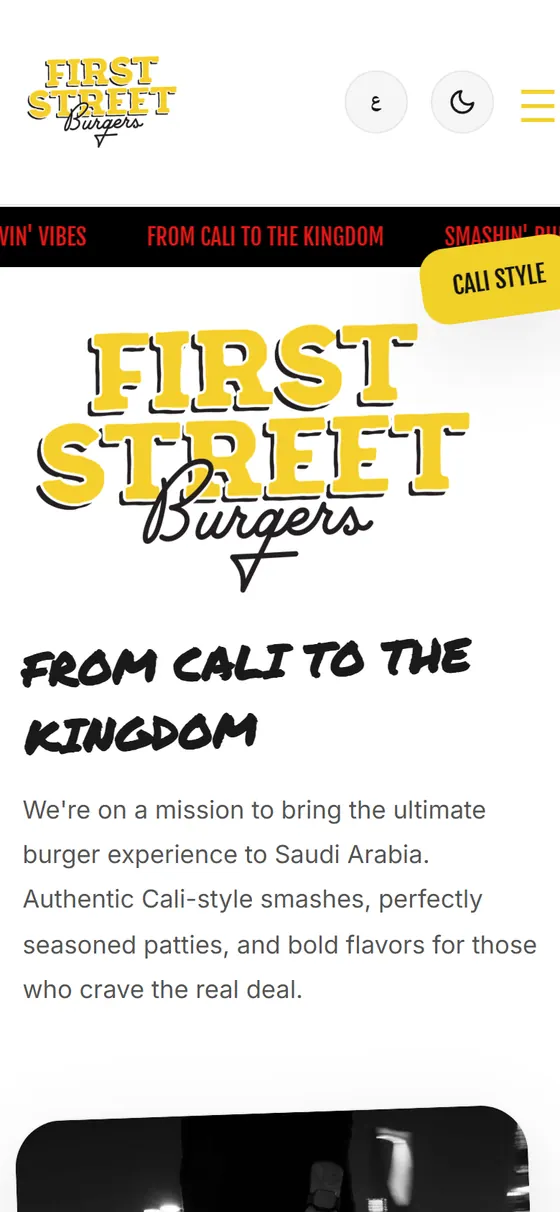
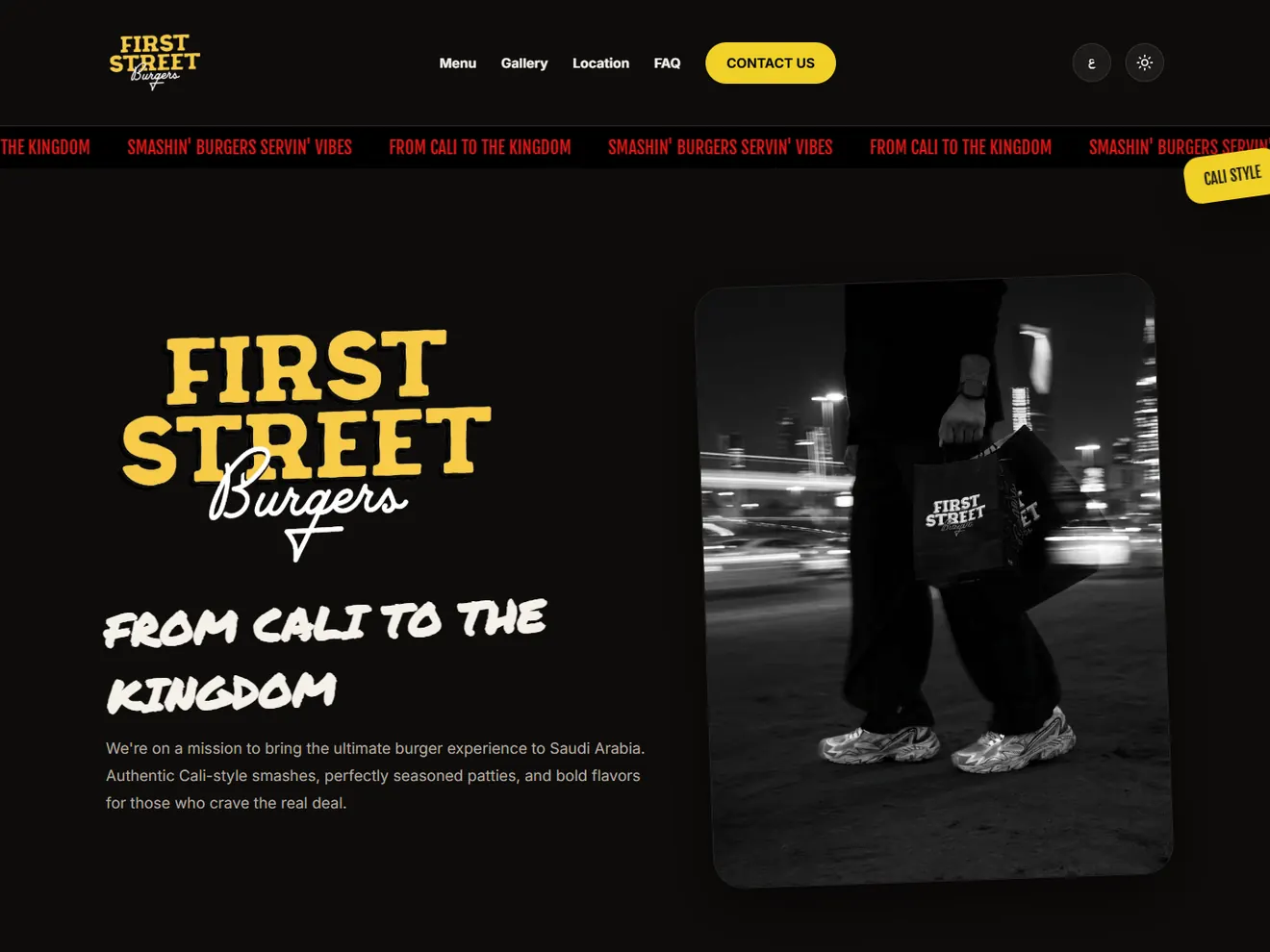
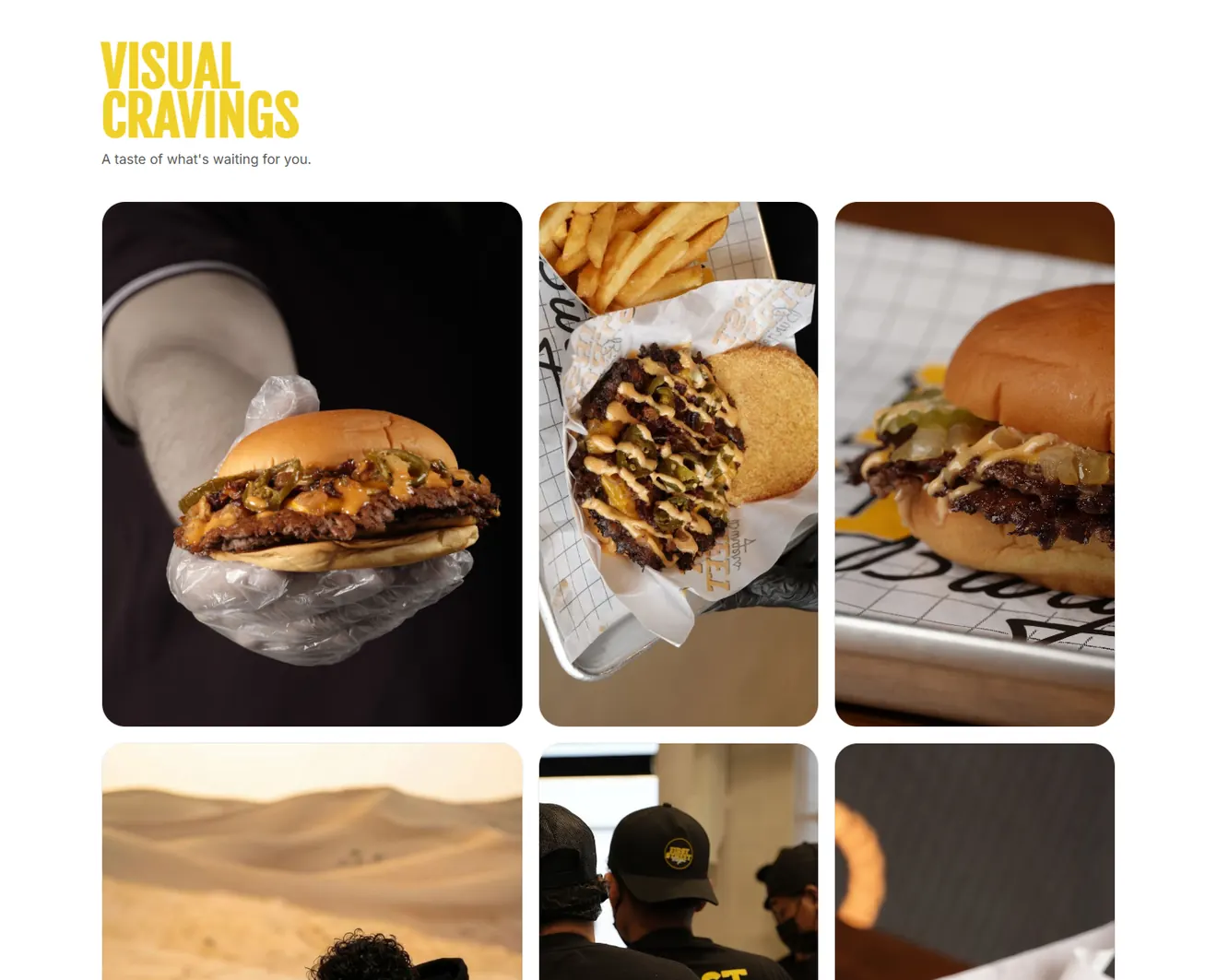
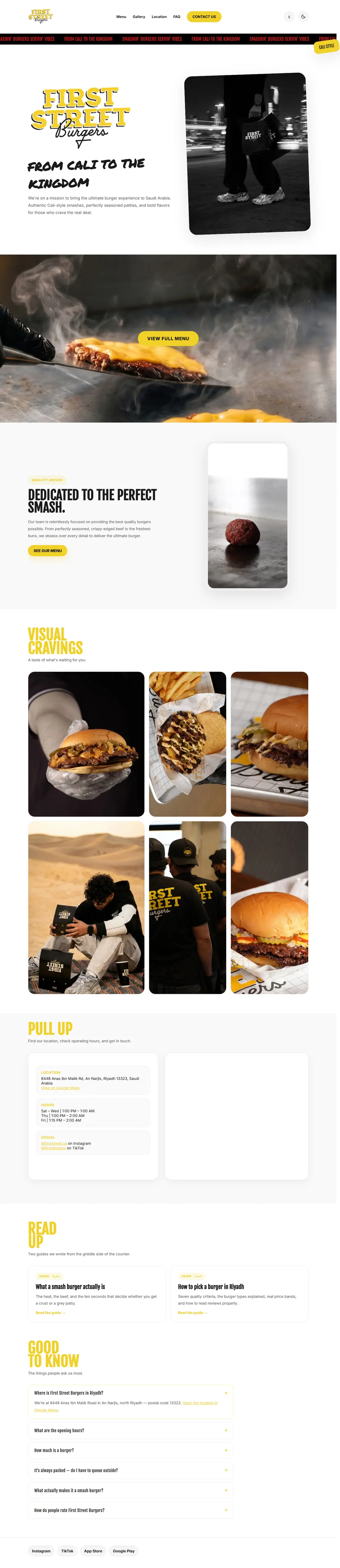
When the page opens, a red ticker runs across it with the restaurant's slogan, followed by the logo, the line "From Cali to the Kingdom" and a large photo. Then comes the griddle shot of a patty being smashed with the menu button on top, a short video inside a phone frame, and six photos from the kitchen and the team. All the copy on the home page can be read in a minute.
A bilingual menu with prices and calories
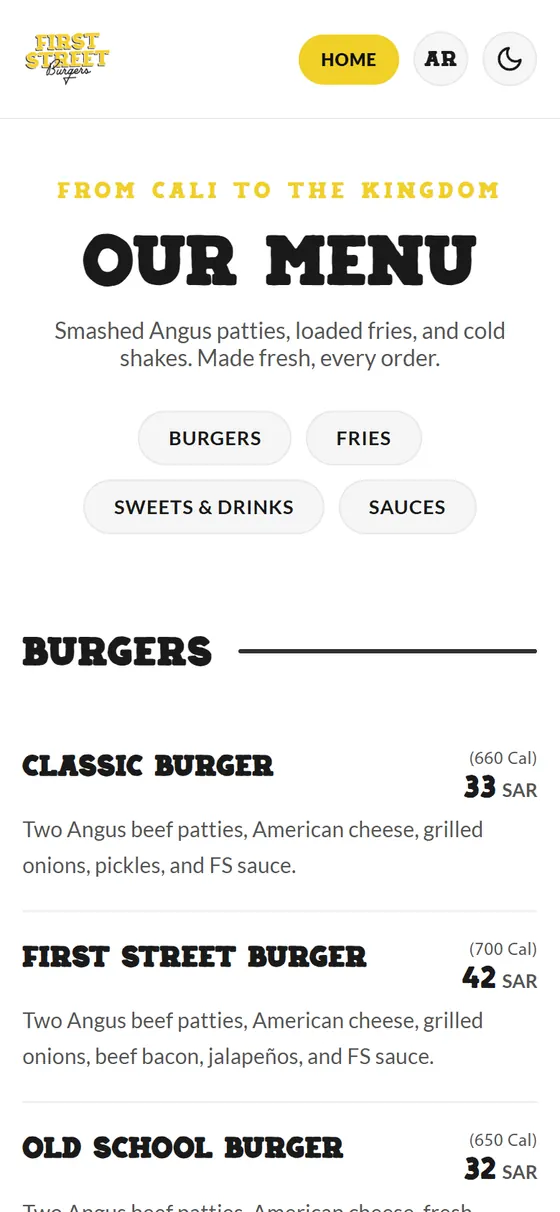
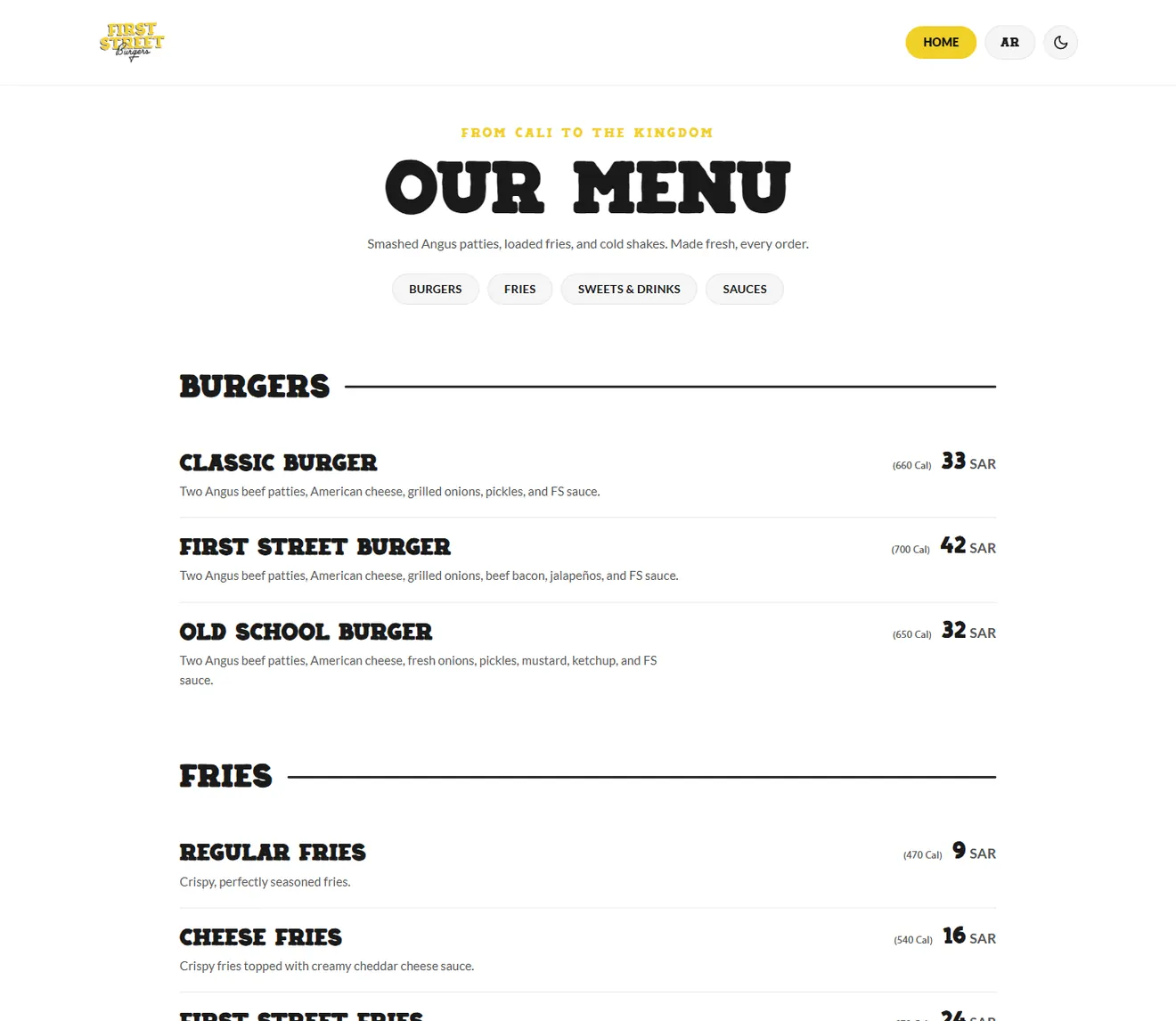
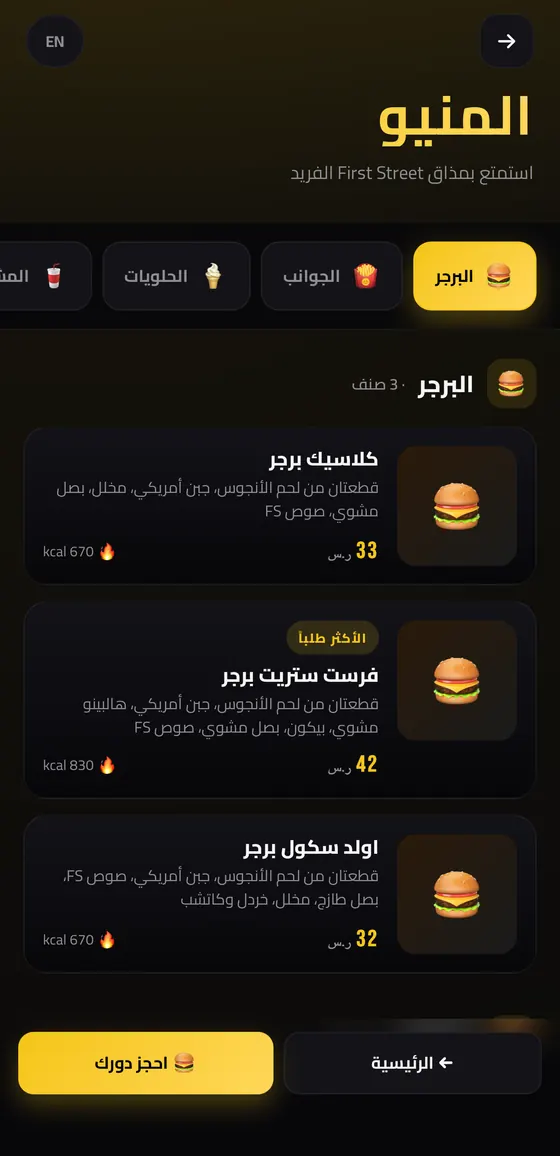
The menu page has four sections with buttons to jump between them: burgers, fries, sweets and drinks, and sauces. Every item shows its ingredients, its price in riyals and its calories, with a note underneath that all prices include VAT. Burgers run from 32 riyals for the Old School to 42 for the First Street Burger, and fries start at 9. One button switches the page between Arabic and English, and the language the visitor picks is remembered.
The same typefaces as the printed menu
The menu on the site uses the printed menu's typefaces: Flavery for item names and headings, Lato for descriptions, Myriad Pro for calories, and Careem for Arabic. Anyone who has seen the menu at the branch recognises the page at a glance. The display face is preloaded alongside the page so item names never flash in a fallback font and then swap.
Light and dark mode without a flash
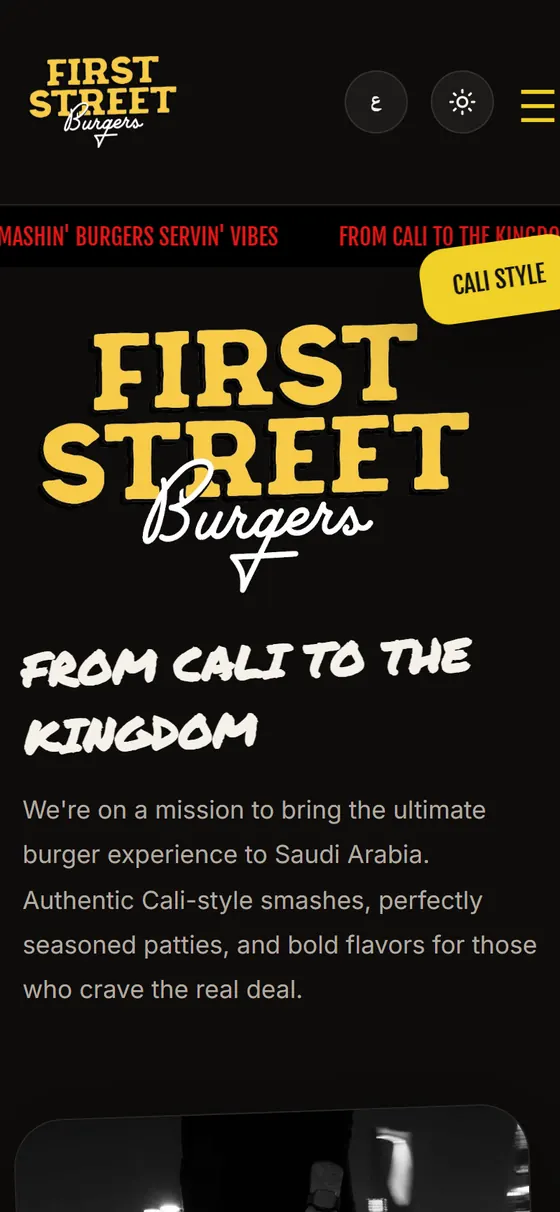
The site reads the visitor's device setting and opens in it, and if the visitor switches mode by hand the choice is saved. The code that sets the mode runs in the head of the page before anything is painted, so there is no white flash when someone opens the site at night in dark mode. The logo has two versions, and the embedded Google map shifts its colours in dark mode.
Address, hours and contact in one section
The location section has the full address with a Google Maps link and an embedded map, the hours for each day, and the Instagram and TikTok accounts. No phone number is published; contact goes through Instagram or the queue app, and llms.txt says so plainly so no tool makes one up.
Six common questions with short answers
Where the restaurant is, when it opens, what a burger costs, whether you have to queue, what makes a burger a smash burger, and how the restaurant is rated. Each question opens to a short answer, and the same answers sit in the FAQPage data. The queue question links to the web booking page and to the app on the App Store and Google Play.
Two Arabic guides of about two thousand words
Each guide has a table of contents at the top, a last-updated date, a reading time, breadcrumbs, tables and an FAQ at the end, and closes with buttons for the menu, the location on the map and booking a spot. The "smash burger Riyadh" guide runs to about 2,300 words and the "best burger in Riyadh" guide to about 2,150.
Print for the branch: gift vouchers and an app QR poster
Next to the site we designed gift vouchers for the restaurant in several styles, in Arabic and English, each with a single-use code. We also built an internal tool that produces the voucher card: a member of staff sets the discount value and the card language and picks one of 15 designs, the tool generates an 8-character code, downloads the card as a PNG, and keeps a log of the codes issued. And we made a "Download the app" poster with two QR codes, one for the App Store and one for Google Play.
Implementation stages
- Research: we pulled search terms about burgers and smash burgers in Riyadh in Arabic and English, split them into brand, local and category, and arrived at 504 target keywords.
- Page map: we assigned the keywords to five pages, one search intent per page, so no two pages compete for the same term.
- Design: we built the English home page on the restaurant's identity: the yellow, the black and the red of the ticker, the Fjalla One and Permanent Marker typefaces, and the restaurant's real photography.
- Arabic version: we wrote the
build-ar.pyscript that generates/arfrom the English page, and reviewed the Arabic copy line by line so it reads naturally rather than translated. - Menu: we moved the printed menu, with its typefaces, prices and calories, onto a bilingual page, and wrote MenuItem data with the price and calories of each dish.
- Guides: we wrote the smash burger guide and the burger buying guide in Arabic, with tables, FAQs and links to the menu.
- Technical SEO: a canonical and hreflang on every page, a sitemap with alternate-language links, structured data, a share image, and icons in every size.
- Answer engines: the llms.txt file and a robots file that names the AI crawlers and lets them in.
- Launch: uploading the files to Hostinger and testing the pages on phone and desktop in both modes.
User experience
A visitor arriving from Google on a phone sees the logo and the first sentence on the first screen, and a side menu with Menu, Gallery, Location, FAQ and a Contact Us button. Next to them sit the language button and the dark mode button. There are no pop-ups and no cookie bar covering the page.
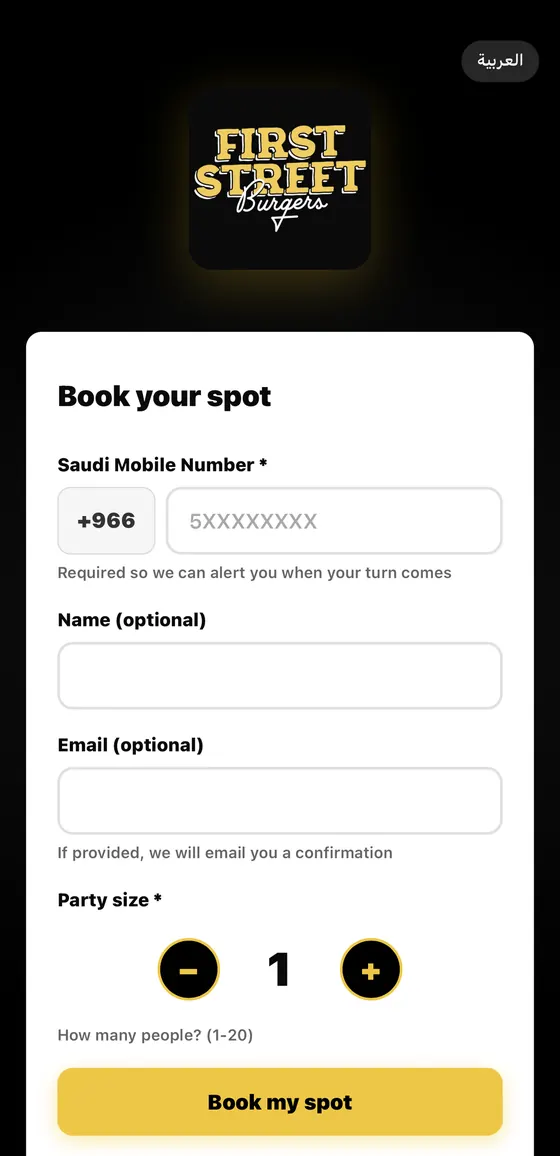
Someone who only wants the price taps Menu and goes straight to the menu, and the section buttons at the top take them to the fries or the sauces without scrolling. Someone planning to come finds the address, the hours and the map link in one section. Someone worried about the queue finds that question answered in the FAQ with the link for booking a spot.
The Arabic version is not a mirror of the English one. The ticker carries Arabic lines of its own, and the headings were written in Arabic from the start rather than translated from "Visual Cravings" or "Pull Up". The 404 page is in Arabic too: it tells the visitor the page does not exist and gives them links to the home page, the menu, the two guides, the location and queue booking.
The pages are light: no framework loads before the content, images load as the visitor reaches them, and only the first image gets loading priority.
Results and impact
The site is live at firststreetburgers.com in Arabic and English, all five pages return 200 and are listed in the sitemap, and the 404 page really does return a 404. Structured data is on every page, and the whole menu, with prices and calories, is written in a form Google can read.
We are not publishing traffic or ranking figures here; that is the restaurant's data. What we can say is that the restaurant now has one official source that speaks for it in two languages, and any change to a price or to the hours is made in one place. And the Arabic version can no longer fall behind the English one, because it is built from it.
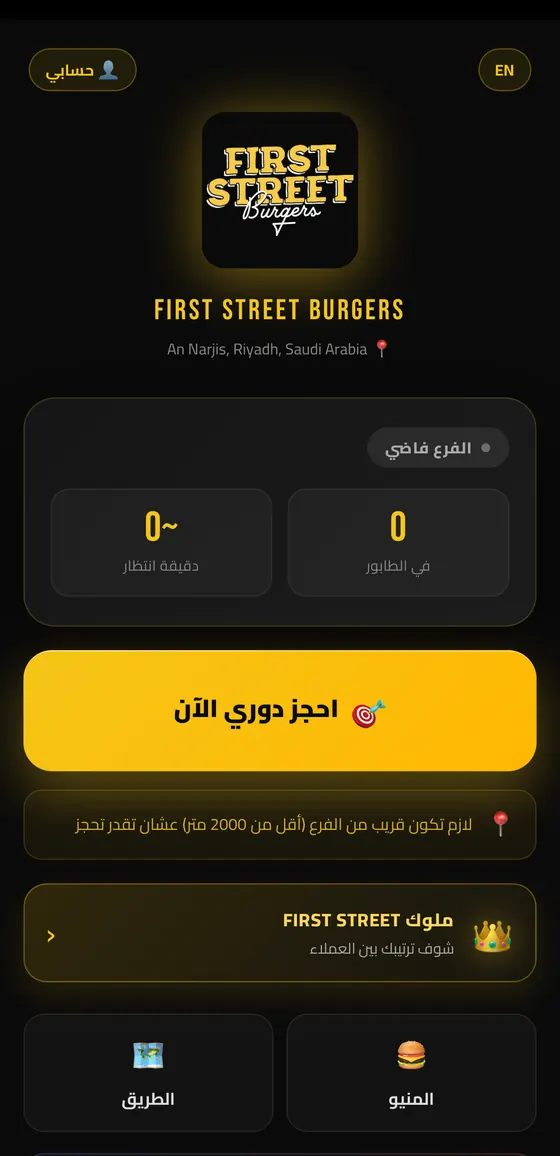
The website and the app now work together: the site answers the questions people have before a visit, and once a diner decides to come it sends them to the queue app to take their place from their phone.
Frequently asked questions
What is the First Street Burgers website?
It is the website of a smash-burger restaurant in An Narjis, Riyadh, built by Younex at firststreetburgers.com. It has an English home page and an Arabic version, a bilingual menu page with prices and calories, and two Arabic guides on smash burgers and choosing a burger in Riyadh.
Does the site sell online?
No. The site introduces the restaurant, its menu, its location and its hours. Ordering happens at the branch, and the crowds are handled by the queue app the site links to.
How is the Arabic version kept up to date?
A Python script builds the /ar page from the English page, swapping only the copy and the metadata and leaving the design alone. Any design change reaches the Arabic page as soon as the script runs, with no copying by hand.
Why does the site have no admin panel?
Because very little of the content changes: an item's price or the hours. So we chose light, ready-made pages with no database, which open quickly and have nothing that needs security updates. Edits are made in the code and uploaded.
What is the llms.txt file for?
It is a text file on the site that sums up the restaurant for tools such as ChatGPT and Perplexity: the address, the hours, the menu with prices, and the pages. When those tools are asked about the restaurant they have an official source to draw on instead of guessing.
How does the website relate to the First Street app?
Both are for the same restaurant and both are Younex work. The website covers the introduction, the menu and search, and the app covers booking a place in the queue and loyalty points. The site links to the app on the App Store and Google Play and to the web booking page.
Does the site work well on phones?
Yes. The pages are designed for phones first, with a side menu and large buttons, and images load as the visitor reaches them. Dark mode is available on both phone and desktop.
What print material was made with the site?
Gift vouchers in several designs, an internal tool that produces the voucher card with its code, value and language and downloads it as an image, and a poster with two QR codes for downloading the app from the App Store and Google Play.